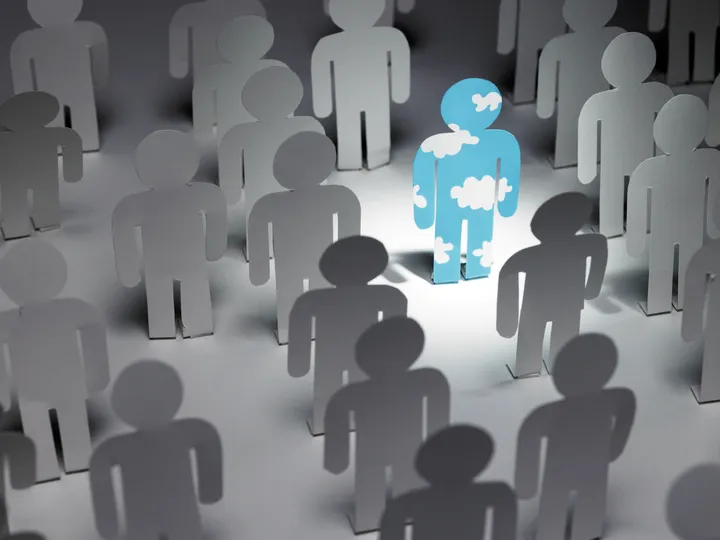
Take a minute and answer this question: Is anyone really normal today?
I mean, even those who claim they are normal may, in fact, be the most neurotic among us, swimming with a nice pair of scuba fins down the river of "Denial." Having my psychiatric file published online and in print for public viewing, I get to hear my share of dirty secrets -- weird obsessions, family dysfunction or disguised addiction -- that are kept concealed from everyone but a self-professed neurotic and maybe a shrink.
"Why are there so many disorders today?" Those seven words, or a variation of them, surface a few times a week. And my take on this query is so complex that, to avoid sounding like my grad school professors making an erudite case that fails to communicate anything to average folks like me, I often shrug my shoulders and move on to a conversation about dessert. Now that I can talk about all day.
Here's the abridged edition of my guess as to why we mark up more pages of the DSM-IV today than, say, a century ago (even though the DSM-IV had yet to be born).
Most experts would agree with me that there is more stress today than in previous generations. Stress triggers depression and mood disorders, so that those who are predisposed to it by their creative wiring or genes are pretty much guaranteed some symptoms of depression at confusing and difficult times of their lives.
I think modern lifestyles -- lack of community and family support, less exercise, no casual and unstructured technology-free play, less sunshine and more computer -- factor into the equation. So does our diet. Hey, I know how I feel after a lunch of processed food, and I don't need to the help of a nutritionist to spot the effect in my 8-year-old son.
Finally, let's also throw in the toxins of our environment. Our fish are dying, a clue that our limbic systems (the brain's emotional center) are not so far behind.
Maybe the same amount of people have genes that predispose them to depression as in the Great Depression. But the lifestyle, toxins and other challenges of today's world tilts the stress scale in the favor of major depression, acute anxiety and their many relatives.
Of course, we can't forget today's technology and cutting-edge research of psychologists, neuroscientists and psychiatrists. Because of medical devices that can scan our brains with impressive precision and the arduous work of scientific studies done in medical labs throughout the country, we know so much more about the brain and its relationship with other biological systems within the human body: digestive, respiratory and circulatory, musculoskeletal and nervous. All of that is a very good thing, as is knowledge and awareness.
A few years ago, psychiatrist and bestselling author Peter Kramer penned an interesting article for Psychology Today rebutting the claims of popular authors -- spawning a new genre of psychological literature -- that doctors are abusing their diagnostic powers, labeling boyishness as "ADHD," normal sadness and grief as "major depression" and shyness as "social phobia." Because of their rushed schedules and some laziness, doctors are narrowing the spectrum of normal human emotion, slapping a diagnosis on all conditions and medicating people who would be better served with a little coaching, direction and psychotherapy.
As I explained in my piece "Are We Overmedicating? Or Is Our Health Care System Inadequate?," I believe the problem is far more complicated than overmedication. I'd be more comfortable labeling it "really bad health care." And if I had to pick a culprit, I'd point my finger at our health care insurance policies, not the doctors themselves. But I don't even want to get into that, because it causes my blood pressure to rise and I'm trying really hard lately to live like a Buddhist monk.
What I liked about Kramer's article is that he doesn't deny that there are more diagnoses today, and yes, some people may feel the damaging effect of stigma. However, more often than not, diagnosis brings relief and treatment to a behavior, condition or neurosis that would otherwise decay certain parts of a person's life, especially his marriage and relationships with children, bosses, co-workers and, dare I say, in-laws? Kramer writes:
"Diagnosis, however loose, can bring relief, along with a plan for addressing the problem at hand. Parents who might have once thought of a child as slow or eccentric now see him as having dyslexia or Asperger's syndrome -- and then notice similar tendencies in themselves. But there's no evidence that the proliferation of diagnoses has done harm to our identity. Is dyslexia worse than what it replaced: the accusation, say, that a child is stupid and lazy?"
"People afflicted by disabling panic or depression may fully embrace the disease model. A diagnosis can restore a sense of wholeness by naming, and confining, an ailment. That mood disorders are common and largely treatable makes them more acceptable; to suffer them is painful but not strange."
Then Kramer asks this question: What would it feel like to live in a world where practically no one was normal? Where few people are free from "psychological defect?" What if normalcy was a mere myth? He ends the article with this poignant paragraph:
"We are used to the concept of medical shortcomings; we face disappointing realizations -- that our triglyceride levels and our stress tolerance are not what we would wish. Normality may be a myth we have allowed ourselves to enjoy for decades, sacrificed now to the increasing recognition of differences. The awareness that we all bear flaw is humbling. But it could lead us to a new sense of inclusiveness and tolerance, recognition that imperfection is the condition of every life."
Amen to that.