
The following is an excerpt from The Age of Austerity: How Scarcity Will Remake American Politics.
The contest for power between Democrats and Republicans pits two antithetical value systems against each other; two conflicting concepts of freedom, liberty, fairness, right, and wrong; two mutually exclusive notions of the state, the individual, and the collective good.
A wide range of academic scholarship exploring political belief-formation reveals that those who identify themselves as politically conservative, for example, exhibit distinctive values underpinning their world view and their orientation towards political competition.
Some of these conservative values can be discerned in public opinion data.
These Pew findings demonstrate that the differences of opinion between liberals and conservatives are far greater than the differences in opinion between men and women commonly referred to as the gender gap.
* * *
The Pew questions are designed to test opinion on public policy issues. The strength of the Pew surveys and other comparable, well-designed polls is that the sample is carefully selected to be representative of either the general public or of all voters. The limitation of such surveys is that they are not designed to reveal more subtle distinctions that can be equally or more significant.
1) WAR, PEACE, VIOLENCE, EMPATHY WITH THE WORLD:
On key questions and statements in this category, liberals scored high, conservatives low: "I believe peace is extremely important"; "Understanding, appreciation, and protection for the welfare of all people and for nature"; "One of the worst things a person could do is hurt a defenseless animal"; "How close do you feel to people all over the world?"
On other key questions in this area, conservatives scored high, and liberals low: "War is sometimes the best way to solve a conflict"; "There is nothing wrong in getting back at someone who has hurt you."
2) CRIME AND PUNISHMENT; MORAL ELASTICITY; AUTHORITY:
Again, on some questions in this category, liberals scored high, conservatives low: "I believe that offenders should be provided with counseling to aid in their rehabilitation"; "What is ethical varies from one situation and society to another."
On other questions, conservatives scored high and liberals low: "People should not do things that are disgusting, even if no one is harmed"; "Respect for authority is something all children need to learn"; "I believe that 'an eye for an eye' is the correct philosophy behind punishing offenders"; "The 'old-fashioned ways' and 'old-fashioned values' still show the best way to live"; "It feels wrong when...a person commits a crime and goes unpunished."
3) THE POOR, REDISTRIBUTION, FAIRNESS:
Liberal high, conservative low: "It feels wrong when . . . an employee who needs their job, is fired"; "I think it's morally wrong that rich children inherit a lot of money while poor children inherit nothing"; "I often have tender, concerned feelings for people less fortunate than me."
Conservative high, liberal low: "[I place a high value on] safety, harmony, and stability of society, of relationships, and of self"; "[It's desirable when] employees [who] contribute more to the success of the company receive a larger share"; "[I value] social status and prestige, control or dominance over people and resources."
4) MORALS, HEDONISM, SELF-FULFILLMENT, HIERARCHY:
Liberals high, conservatives low: "I see myself as someone who . . . is original, comes up with new ideas"; "Pleasure or sensuous gratification for oneself"; "What is ethical varies from one situation and society to another."
Conservative high, liberal low: "If certain groups stayed in their place, we would have fewer problems;" "People should be loyal to their family members, even when they have done something wrong;" "Respect, commitment, and acceptance of the customs that traditional culture provide"; "[I favor] restraint of actions, inclinations, and impulses likely to upset or harm others and violate social expectations or norms."
From a different vantage point -- taking data from American National Election Studies (ANES) surveys conducted between 1972 and 2004, the University of Virginia's Nicholas Winter analyzed the words respondents used to describe the two political parties. In "Masculine Republicans and Feminine Democrats: Gender and Americans' Explicit and Implicit Images of the Political Parties," Winter categorized words respondents volunteered as stereotypically "male" or "female:"
[M]asculine men are thought to be active, independent, and decisive; feminine women are thought to be compassionate, devoted to others, emotional, and kind. These core traits are linked with a range of other features, including other traits (masculine men are aggressive, practical, tough, hardworking, and hierarchical; feminine women are gentle, submissive, soft, ladylike, and egalitarian); physical characteristics (masculine men are big, strong, and muscular; feminine women are small, weak, and soft-spoken).
At the same time, Winter writes, polls show:
Republicans are thought to handle better such issues as defense, dealing with terrorism, and controlling crime and drugs; these are precisely the sorts of issues that Americans associate with men or with masculine traits. Conversely, Democratic-owned issues include education, health care, helping the poor, protecting the environment, and promoting peace; these are all also associated with women or with feminine traits.
In summary, Winter found:
During the past three decades Americans have come to view the parties increasingly in gendered terms of masculinity and femininity. Utilizing three decades of American National Election Studies data . . . this paper demonstrates empirically that these connections between party images and gender stereotypes have been forged at the explicit level of the traits that Americans associate with each party, and also at the implicit level of unconscious cognitive connections between gender and party stereotypes. These connections between the parties and masculinity and femininity have important implications for citizens' political cognition and for the study of American political behavior.
When it comes to partisan confrontation, Democrats and Republicans are, arguably, different breeds. As Jonathan Haidt of the University of Virginia writes,
[T]hink of the moral mind as being like an audio equalizer, with five slider switches for different parts of the moral spectrum. Democrats generally use a much smaller part of the spectrum than do Republicans. The resulting music may sound beautiful to other Democrats, but it sounds thin and incomplete to many of the swing voters that left the party in the 1980s, and whom the Democrats must recapture if they want to produce a lasting political realignment.
These differences are more than skin deep, and become significant in political fights over scarce resources. Republican resistance to accommodation can have serious consequences: austerity policies adopted by Congress -- as well as by state and local governing bodies (which are bound by law to maintain balanced budgets) -- will fall heavily on domestic spending, especially on programs and services for the disadvantaged and the poor, i.e. Democratic voters.
Not only are the disadvantaged less well-equipped to press their case, insofar as power correlates with cash, but their primary defenders, contemporary liberals, often flinch in warfare over resources. Scarcity seems to play to the psychological and competitive strengths of conservatives, reinforcing their hierarchical and authoritarian preferences, while increasing the likelihood that those on the left will compromise and concede on matters large and small.
Personality Traits Theorized to be Associated with Liberal (or Left-Wing) and Conservative (or Right-Wing) Orientation, 1930 -- 2007
Liberal/Left-Wing
Slovenly, ambiguous, indifferent, eccentric, sensitive, individualistic; open, tolerant, flexible; life-loving, free, unpredictable; creative, imaginative, curious; expressive, enthusiastic; excited, sensation-seeking; desire for novelty, diversity; uncontrolled, impulsive; complex, nuanced; open-minded; open to experience.
Conservative/Right-Wing
Definite, persistent, tenacious; tough, masculine, firm; reliable, trustworthy, faithful, loyal; stable, consistent; rigid, intolerant; conventional, ordinary; obedient, conformist; fearful, threatened; xenophobic, prejudiced; orderly, organized; parsimonious, thrifty, stingy; clean, sterile; obstinate, stubborn; aggressive, angry, vengeful; careful, practical, methodical; withdrawn, reserved; stern, cold, mechanical; anxious, suspicious, obsessive; self-controlled; restrained, inhibited; concerned with rules, norms; moralistic; simple, decisive; closed-minded; conscientious.
1. Some groups of people are just more worthy than others
2. In getting what your group wants, it is sometimes necessary to use force against other groups
3. It's OK if some groups have more of a chance in life than others
4. To get ahead in life, it is sometimes necessary to step on other groups
5. If certain groups of people stayed in their place, we would have fewer problems
6. It's probably a good thing that certain groups are at the top and other groups are at the bottom.
7. Inferior groups should stay in their place
8. Sometimes other groups must be kept in their place
9. It would be good if all groups could be equal
10. Group equality should be our ideal
11. All groups should be given an equal chance in life
12. We should do what we can to equalize conditions for different groups
13. We should increase social equality
14. We would have fewer problems if we treated different groups more equally.
15. We should strive to make incomes more equal
16. No one group should dominate in society
While Carney, Jost, Sidanius, et al. describe conservatives in pejorative terms, the University of Virginia's Jon Haidt and Jesse Graham of the University of Southern California, contend that liberal scholars may be restricting their definition of morality by failing to acknowledge values and principles important to conservatives.
Haidt and Graham submit that conservatives are concerned not only with the welfare and rights of the individual, but also with the institutions of family, patriotism, loyalty to one's group, and recognition of the legitimacy of hierarchy and order as beneficial to the larger society. As a result, according to Haidt and Graham, conservatives will sometimes take what they see as moral stands -- attacking abortion and divorce as undermining the family -- that liberals may well see as immoral impositions on the autonomy of individuals, especially women.
FIGURE 2
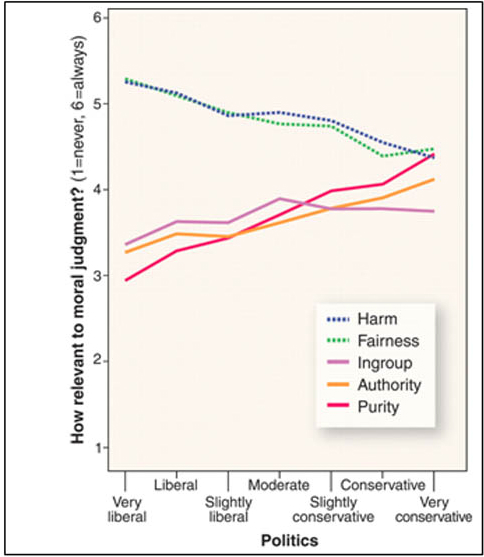
In interpreting their data, Haidt and Graham write that
"justice and related virtues . . . make up half of the moral world for liberals, while justice-related concerns make up only one fifth of the moral world for conservatives. Conservatives have many moral concerns that liberals simply do not recognize as moral concerns. When conservatives talk about virtues and policies based on the in-group/loyalty, authority/respect, and purity/sanctity foundations, liberals hear talk about theta waves [i.e., from outer space]. For this reason, liberals often find it hard to understand why so many of their fellow citizens do not rally around the cause of social justice, and why many Western nations have elected conservative governments in recent years."
Haidt and Graham look at the issue of 'harm' not from the viewpoint that conservatives are more willing to inflict it, but from the other end of the telescope, that liberals place a higher value than conservatives on avoiding inflicting harm.
This distinction is crucial. There is a strong tendency in the social sciences to demonize Republicans and the right. The result is often a caricature rather than an accurate portrayal of conservatism and the values it represents. Without an accurate portrait of conservatism, the outcome of elections in which majorities periodically back conservative candidates cannot be fully understood.
Recognizing the danger that "behavioral research . . . runs the risk of becoming an extension of the political struggle between left and right," two other researchers, Philip Tetlock of the Wharton School, and Gregory Mitchell of the University of Virginia Law School, have tried to look objectively at "flattering and unflattering cognitive and motivational characterizations of liberals and conservatives," and with the aim of producing a more balanced view of the competing value systems of left and right.
1. Flattering liberal portrait:
"They [Liberals] do not equate downtrodden or impoverished status with inherent unworthiness or inability . . . In a nutshell, liberals are less selfish and more empathic and tolerant than conservatives. Their fear of aiding the undeserving is outweighed by their fear not helping the truly needy . . . Liberals do not need to bolster their self-esteem by living in a stratified society in which they can claim superiority over this or that group . . . Finally, liberals do not blame the victim or make defensive attributions . . . Liberals acknowledge that fate can be capricious and that bad things happen to good people."
2. Flattering conservative portrait:
"Conservatives realize the importance of incentives and that no, or little, aid is often the best help of all. The conservative response to social problems avoids the simplistic first response of treating the symptom by creating a new and expensive government program . . . conservatives are more integratively complex than liberals because they understand how often well-intentioned political reforms have unintended consequences or perverse effects . . . Finally, conservatives understand how free markets work, [they] recognize that the invisible hand of free market competition leads in the long term to incentives to produce good at levels of quality and quantity that satisfy effective demand for those goods."
3. Unflattering liberal portrait:
"They practice, in effect, a kind of social homeopathic medicine that treats symptoms rather than underlying causes . . . They fail to take into account the growing burden on the economy and the perverse incentives that dependency on public programs creates . . . Liberals not only exaggerate the efficacy of government; they underestimate the creativity of the free market. Many liberals mindlessly condemn capitalism as a culture of greed and ignore the power of the market to stimulate hard work, investment and entrepreneurship . . . [Liberalism] is a reflection of the widespread 'psychology of dependency' in which government, by transference, takes on the role of nurturant, powerful parent."
4. Unflattering conservative portrait:
"[C]onservatives do not understand how prevalent situational constraints on achievement are and thus commit the fundamental attribution error when they hold the poor responsible for poverty . . . [C]onservatives are too prone to engage in zero-sum thinking, either I keep my money or the government takes it. They fail to appreciate the possibility of positive-sum resolutions of societal conflicts . . . Conservatives cling to the comforting moral illusion that there is a sharp distinction between allowing people to suffer and making people suffer. Finally, conservatives fail to recognize that even if each transaction in a free market meets their standards of fairness, the cumulative result could be colossally unfair. Some people will acquire enormous power over others . . . [C]onservatism and compassion are antithetical."
These findings demonstrate the danger of demonizing the left or right. Instead, a balanced approach to the strengths and weaknesses of each position -- recognizing the salience of Tetlock and Mitchell's 'flattering' and 'unflattering' characterizations -- is essential to understanding how it is possible for the electorate to shift back and forth from election to election.
At the state and federal level, Republicans justify budget cuts in basic health and welfare programs by positing that the poor are responsible for their condition; emphasizing the costs of social welfare policies and the tax burdens that such benefit programs impose on the middle class; alleging that the consequences of denied food stamps or medical care can be absorbed in the larger scheme of things; asserting that market forces provide better solutions than government handouts; and believing that requiring people to shoulder hardship has salutary effects.
Under conditions of scarcity, a significant number of 'discipline' oriented Americans will be drawn to the hard-edged doctrines of conservatism, providing support to the Tea Party and to the moral orientation of the current Republican House. Conditions of scarcity work to the advantage of conservatives, undermining the willingness of voters to sacrifice -- pay higher taxes -- for the less fortunate.
In contrast, periods of economic growth work to the advantage of those on the left, who are more committed to values of 'nurturance' and care. These voters feel the suffering of others, their compassion is intensified by the sight of the jobless and homeless and hopeless. They believe that a helping hand is morally appropriate and benefits the larger polity. Democrats depend on such voters for core support. In times of plenty, voters in the center can find themselves sympathetic to this position.
***
In many ways, the politics of austerity go to the heart of the problem of 'loss allocation' posed by MIT economist Lester Thurow in his 1980 book, The Zero-Sum Society.
Republicans are willing to allocate losses in ways that harm their adversaries, if the outcomes favor their own interests and are consistent with conservative value systems. Large numbers of voters -- indeed, intermittent majorities -- appear to agree with GOP values when decisions about loss allocation must be made, even though these values are anathema to the disadvantaged and to ideological liberals.
In 2008, for example, Obama's core constituency of blacks, 'netroots," creatives, single women, young voters, and Hispanics was augmented by a sizeable number of white swing voters who were put off by Bush himself, by the Iraq war, and by the financial collapse of September 2008 -- as well as by John McCain's weak campaign and by his choice of Sarah Palin as his running mate. Two years later, many of these same swing voters, angered by continuing unemployment, ballooning deficits, and the perceived distributional impact of health care reform, swept House Democrats out of office.
The 2012 election will be a battle for the hearts and ballots of these same voters in what is shaping up as the most ideological confrontation in recent memory.
This excerpt first appeared at www.theatlantic.com.
This post has been expanded from an earlier version that appeared on Wednesday, February 8, 2012.
Linda J. Skitka and Philip E. Tetlock, "Providing Public Assistance: Cognitive and Motivational Processes Underlying Liberal and Conservative Policy Preferences," Journal of Personality and Social Psychology 65 (1993): 1205-23, available at http://faculty.haas.berkeley.edu/tetlock/Vita/Philip%20Tetlock/Phil%20Tetlock/1992-1993/1993%20Providing%20Public%20Assistance....pdf.
Pew Research Center for the People & the Press. "Independents Oppose Party in Power . . . Again: More Conservative, More Critical of National Conditions," September 23, 2010, available at http://people-press.org/report/658/.
Ibid.
YourMorals.org. Accessed March 21, 2011, available at http://www.yourmorals.org/aboutus.php.
Thomas B. Edsall, Building Red America. New York: Basic, 2000. "The Democratic Party, conversely, is the party of the so-called 'subdominant' and of those who identify with the subdominant, including those upper-income voters who have taken the side of the insurgents in the sexual, women's rights, and civil rights revolutions. Roughly two-thirds of the Democratic party's adherents are Americans who struggle to survive in an increasingly brutal competitive environment. The party is also the representative of organized labor and of the leadership of old-line religious denominations -- institutions in decline." p.1.
Polipsych.com. Accessed March 21, 2011, available at http://www.polipsych.com/.
Polipsych.com. "Differences between White Male Liberals and White Male Conservatives," October 27, 2010, available at http://www.polipsych.com/2010/10/27/differences-between-white-male-liberals-and-white-male-conservatives/. The site has a link to the same data for white female liberals and conservatives.
Thomas B. Edsall, "Women's Political Muscle Shapes 2000 Race," The Washington Post, March 11, 1999.
James C. Dobson, Dare to Discipline. Illionois: Tyndale House, 1977. "[P]ain is a marvelous purifier . . . It is not necessary to beat the child into submission; a little bit of pain goes a long way for a young child. However, the spanking should be of sufficient magnitude to cause the child to cry genuinely," p. 16 and p. 23.
George Lakoff, Moral Politics. Chicago: University Of Chicago Press, 2002. "The conservative/liberal division is ultimately a division between strictness and nurturance as ideals at all levels -- from the family to morality to religion and, ultimately, to politics. It is a division at the center of our democracy and our public lives, and yet there is no overt discussion of it in public discourse. The reason is that the details are largely unconscious, part of what cognitive scientists call the Cognitive Unconscious -- a deep level of mind that we have no direct access to. Yet it is vitally important that we do so if Americans are to understand and come to grips with, the deepest fundamental division in our country, one that transcends and lies behind all the individual issues; the role of government, social programs, taxation, education, the environment, energy, gun control, abortion, the death penalty, and so on. These are ultimately not different issues, but manifestations of a single issue; strictness versus nurturance." p. x.
Nicholas Winter, "Masculine Republicans and Feminine Democrats: Gender and Americans' Explicit and Implicit Images of the Political Parties." Paper presented at the American Political Science Association Toronto Meeting, 2009, available at http://papers.ssrn.com/sol3/papers.cfm?abstract_id=1451343.
Ibid.
Ibid.
Ibid.
Jonathan Haidt, "What Makes People Vote Republican?" Edge, September 9, 2008, available at http://www.edge.org/3rd_culture/haidt08/haidt08_index.html.
Susan Page, "Poll: Dems, GOP divided on how to move forward," USA Today, November 8, 2010, available at http://www.usatoday.com/news/politics/2010-11-08-post-election-poll_N.htm.
Jonathan Weisman and Danny Yadron, "Poll Supports Shift to Center," Wall Street Journal, December 14, 2010, available at http://online.wsj.com/article/SB10001424052748704828104576021900230935000.html?mod=WSJ_WSJ_US_News_5.
Dana R. Carney, John T. Jost, Samuel D. Gosling, and Jeff Potter, "The Secret Lives of Liberals and Conservatives: Personality Profiles, Interaction Styles, and the Things They Leave Behind," Political Psychology 29 (2008): 807-40, available at http://www.psych.nyu.edu/jost/Carney,%20Jost,%20&%20Gosling%20(2008)%20The%20secret%20lives%20of%20liberals%20.pdf.
Ibid.
Ibid.
Felicia Pratto, Jim Sidanius, and Shana Levin, "Social dominance theory and the dynamics of intergroup relations: Taking stock and looking forward," European Review of Social Psychology 17 (2006): 271-320. The appendix lists the questions used to determine SDO.
Ibid.
Felicia Pratto, James Sidanius, Lisa M. Stallworth, and Bertram F. Malle, "Social Dominance Orientation: A Personality Variable Predicting Social and Political Attitudes," Journal of Personality and Social Psychology 67 (1994): 741-763, available at http://dash.harvard.edu/bitstream/handle/1/3207711/Sidanius_SocialDominanceOrientation.pdf?sequence=1.
Jesse Graham, Jonathan Haidt, and Brian A. Nosek, "Liberals and Conservatives Rely on Different Sets of Moral Foundations," Journal of Personality and Social Psychology 96 (2009): 1029-46, available at http://www4.gsb.columbia.edu/rt/null?&exclusive=filemgr.download&file_id=7214828&rtcontentdisposition=filename%3DGraham_Jesse_paper.pdf.
Jesse Graham, Jonathan Haidt, and Brian A. Nosek, "Liberals and Conservatives Rely on Different Sets of Moral Foundations," Journal of Personality and Social Psychology, 2009, Vol. 96, No. 5, 1029--1046, American Psychological Association, available at http://people.virginia.edu/~jdh6n/
Jonathan Haidt and Jesse Graham, "When Morality Opposes Justice: Conservatives Have Moral Intuitions that Liberals may not Recognize," Social Justice Research (2007), available at http://papers.ssrn.com/sol3/papers.cfm?abstract_id=872251
P.E Tetlock and P.G. Mitchell, "Liberal and conservative approaches to justice: Conflicting psychological portraits," in Psychological Perspectives on Justice, edited by B. Mellers & J. Baron (Cambridge: Cambridge University Press, 1993), available at http://faculty.haas.berkeley.edu/tetlock/Vita/Philip%20Tetlock/Phil%20Tetlock/1992-1993/1993%20Liberal%20and%20Conservative%20Approaches%20to%20Justice.pdf.
Ibid.
American National Election Studies. "Military Spending, 7 Point Scale (1980-2008)," accessed July 12, 2011, available at http://www.electionstudies.org/nesguide/toptable/tab4d_3b.htm.
Suzanne Goldenberg and Elana Schor, "Obama supports supreme court reversal of gun ban: Candidate's stance at odds with former position: Democrat backs death penalty for child rapist," GuardianUK, June 27, 2008, available at http://www.guardian.co.uk/world/2008/jun/27/barackobama.usa.
Paul Kane, "Obama Supports FISA Legislation, Angering Left," Washington Post, June 20, 2008, available at http://voices.washingtonpost.com/44/2008/06/20/obama_supports_fisa_legislatio.html.
Barack Obama, "We Need Fathers To Step Up," Parade Magazine, June 21, 2009, available at http://www.parade.com/news/2009/06/barack-obama-we-need-fathers-to-step-up.html.
Mark Gersh, "Swing Voters," DLC, accessed June 12, 2011, available at http://www.dlc.org/print.cfm?contentid=252802. Michiko Kakutani, "The Republican Collapse May Not Be So Imminent," New York, Times, September 12, 2006, available at http://www.nytimes.com/2006/09/12/books/12kaku.html?pagewanted=all.
Alan I. Abramowitz and Bill Bishop, "Myth of the Middle," Washington Post, March 1, 2007, available at http://www.washingtonpost.com/wp-dyn/content/article/2007/02/28/AR2007022801817.html.