
iPhone app iPad app Android phone app Android tablet app More

Featuring fresh takes and real-time analysis from HuffPost's signature lineup of contributors
Thomas Worcester

GET UPDATES FROM Thomas Worcester
 

St. Benedict vs. Rugged Individualism

Posted: 07/11/2012 7:49 am

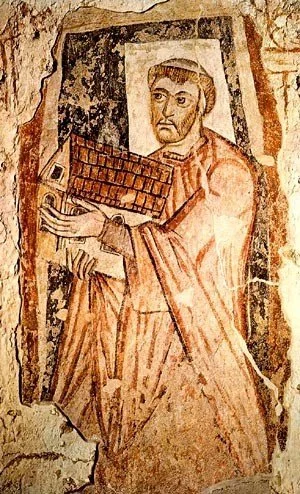
July 11 marks the feast of St. Benedict in the Catholic Church's calendar. Benedict (ca. 480-550) may at first glance seem quite remote, at least as compared with heroes of July 4th and American independence such as George Washington or Thomas Jefferson. For Benedict not only lived a millennium and a half ago, and in Italy, but he was a celibate monk. He is best known for the rule he wrote for monasteries.

I would like to suggest that at least some of the wisdom found in the Rule of St. Benedict could well inform and guide current U.S. debates about immigrants, health care, taxation policies, and balance between work and the rest of life.

After a period of studies in Rome, the young Benedict withdrew for a time from most human contact in order to live in a cave as a hermit devoted to solitude and prayer. But after a while he left his solitude and founded a monastic community at Monte Cassino, and it was initially for this monastery that he wrote his Rule. Rejecting extreme versions of monastic life, such as that of desert ascetics, Benedict prescribes a community life of work and prayer, in which humble, faithful service of others takes precedence over spectacular individual accomplishments. Such service of others, not competition with each other, is the ideal he promotes.

Care of the sick is a matter to which the Rule gives no small attention. Indeed, Benedict states that such care must rank above all other concerns, so that the sick may be served as Christ. Citing Matthew 25, Benedict insists that to visit the sick is to visit Christ, and that what one does for the least of one's brothers one does for Christ. And thus the abbot must insure that the sick suffer no neglect; and the sick must be allowed special privileges, such as the eating of meat. Today, Americans continue to debate whether or not to guarantee access to health care and how to make health care affordable. In Massachusetts, the state legislature recently debated whether or not to fund dental care for Medicaid recipients. A disgraceful compromise offered would provide care for front teeth only, and leave the poor with no care for other teeth. Many states offer no dental care at all to the poor. I dare say that St. Benedict's prioritization of care for the sick above other matters offers a better example to contemplate and imitate.

In the Rule of St. Benedict, guests, too, are to be received as Christ. For Benedict, the monastery is not to be simply an enclosed oasis, but rather it is to be a place of welcome for guests, for the poor, for pilgrims. One thing Benedict does not do is establish criteria for distinguishing what could be imagined as suitable or unsuitable guests; rather, all guests who present themselves are to be welcomed as Christ. Again citing Matthew 25, the Rule states that strangers are welcomed as Christ: they should be greeted with a kiss of peace; with their hands and feet washed by the monks, guests should dine at the abbot's table; maximum care and solicitude is to be shown to the poor and to pilgrims, for in them, even more than in others, Christ is received. Thus it is a very, very long way indeed from Benedict's ideals to the present realities of using immigrants as scapegoats for unemployment or crime, and of illegal "aliens" languishing in American prisons. Something of Benedict's zeal for caring reception of various guests could benefit the U.S. by substituting welcome for contempt for the stranger and the foreigner.

Citing repeatedly the Acts of the Apostles, chapter 4, on goods held in common by Christian communities, Benedict insists on rooting out the "evil" of private ownership. Distribution of goods, in the monastery, is to be according to needs, and goods should be regarded as the possession of all. While such communalism, or communism, may frighten and shock Americans worshipping at the altar of rugged individualism, promotion of the common good is surely more biblical than the so-called "free" market that produces ever larger disparities between rich and poor. No doubt Benedict's rejection of private property may not easily be adopted outside a context such as a monastery, but there are plenty of ways of sharing goods, at least to some extent. One of them is through vigorous, progressive taxation of the healthy and wealthy, so that the needs of others may be met. Recently, François Hollande, president of France, proposed a tax of 75 percent on annual incomes above 1 million euros. Would that American politicians had such courage! St. Benedict, whose title includes that of patron of Europe, would likely approve of Monsieur Hollande's tax policies.

The Rule of St. Benedict details a daily schedule in which various times of community prayer alternate with times of work, times of rest, times of silent prayer and reading. This balanced approach to daily life may contrast rather sharply with the frenzied and frantic daily experiences of many Americans in an age in which some persons are forced to hold two or three poorly paid jobs, while other persons wallowing in wealth. It is a noisy age, one of omnipresent cell phones, sound bites and of attention spans rarely lasting more than a minute. If one is unable to pay attention, one is, among other disabilities, incapable of prayer. Monasteries such as the Weston Priory or St. Joseph's Abbey, both in New England, offer the visitor a taste of a way of a life enduring in its attractiveness, even though, and also because, that way seems at odds with so much of life today.

St. Benedict is a saint, a wisdom figure, a model who can inspire and challenge laity and clergy, Catholics and others, men and women, certainly not only medieval monks or nuns, but all persons in the 21st century. For Americans given over to unlimited individualism and a loud, relentless acquisition of material things, he may be difficult to accept, but he offers a precious example of a life more fully human, a life of balance, of sharing of material things and of care for one another.

 
FOLLOW RELIGION
July 11 marks the feast of St. Benedict in the Catholic Church's calendar. Benedict (ca. 480-550) may at first glance seem quite remote, at least as compared with heroes of July 4th and American indep...
 
 
  • Comments
  • 42
  • Pending Comments
  • 0
  • View FAQ
Comments are closed for this entry
View All
Favorites
Bloggers
Recency  | 
Popularity
Page: 1 2  Next ›  Last »  (2 total)
This user has chosen to opt out of the Badges program
photo
12:06 AM on 07/19/2012
When the Roman Church returns to St. Benedict's Rule as a basis for life and praxis, for everyone from the pope on down, then and only then will it have a chance to renew itself in head and members. Otherwise, it continues down the road leading to irrelevancy.and the trash bin of history.
photo
Indigo1941
Time traveler.
09:20 AM on 07/17/2012
Service to others is service to the gods.
photo
HUFFPOST BLOGGER
Gareth Harris
Scientist, Priest, SentimentalStargazer.com
08:19 AM on 07/15/2012
In my travels about this planet, I been a guest in monasteries and always remember the honor and kindness I received there, regardless of my status as Christian or atheist.

Every athlete knows the importance of strengthening muscles through exercise. And every doctor and patient knows the withering of those muscles that are not active. The weakest muscle in Americans is the humility muscle, withering away and reminding me of the saying from the Tao de Ching:
All streams flow to the sea
because it is lower than they are.
Humility gives it its great power.

Maybe the meek really do inherit the Earth.

-- Fr. Gareth Scott Harris, SentimentalStargazer.com
09:43 PM on 07/14/2012
Article above said that Massachusetts is the most Catholic state and they are the one state with universal health care. Makes sense. Rugged individualism only gets you so far. Massachusetts is one of the wealthiest and healthiest states. People need to work together.
photo
HUFFPOST SUPER USER
TheWM
aka The Wrong Monkey
03:46 PM on 07/12/2012
"St. Benedict vs. Rugged Individualism"

I'll take door #3, please.

There's no doubt that Benedict did a lot of good with his rule, but that's in large part because the Dark Ages were, indeed, so very dark.
photo
Indigo1941
Time traveler.
09:19 AM on 07/17/2012
Much like our own times but without air conditioning.
photo
HUFFPOST SUPER USER
Louis Gonzales
07:37 PM on 08/06/2012
I could have never survived those Dark Hot times! :D
HUFFPOST SUPER USER
larry cifuentes
07:34 AM on 07/12/2012
A great article? describing the tradition of loving to Play Doctor, to be going back long way?

Keep the eye on the ball Thomas. If you can't deliver the actual process of deification, stop and ask.
But in no way divert from the issue, using the traditional method of "Interpreting the word," of any great past personage.

Keep in mind, "The way," is for everybody to be wealthy now.
If can't deliver that, then stop and think again and don't forget to ask.
HUFFPOST SUPER USER
charlesrfd2003
Proud American who believes in the Bill of Rights
08:49 PM on 07/11/2012
Very good article. I will take a copy of it to our liturgy tonight with a third order Benedictine. Third order is a monastery without walls for those who live in the world. Thank you.
photo
HUFFPOST SUPER USER
Jay Patel
06:06 PM on 07/11/2012
Thank you for the wonder article about this great saint.
04:35 PM on 07/11/2012
I think St. Benedict would be disappointed in your interpretation. We need to treat the sick, the poor, the stranger with kindness and compassion. We should not encourage the sick, the poor, and the stranger to deliberately hurt themselves and their children as our current government programs do. He would not agree with the modern insistence that work is demeaning. He felt that work was a good and necessary part of life. He encouraged sharing, not forced distribution. The modern progressive ideal would be quite foreign to him. It is too thoughtless and naive.
photo
HUFFPOST SUPER USER
John Ramsey001
07:27 PM on 07/11/2012
Couple of questions for you from and Independent voter and thinker.

1. How are the poor and sick deliberately hurting themselves and their children?
2. How do current government program contribute to the sick and poor hurting themselves deliberately?
3. Who says that work is demeaning?
4. Who or what is forcing distribution when it comes to material things such as money?
photo
dpkjj
Peace on Earth
03:51 PM on 07/18/2012
I believe he is living in a fantasy world that rationalizes the failure to take responsibility for our fellow humans, especially those who are poor, sick, hurting, or a stranger in our midst.
HUFFPOST SUPER USER
Anne Rutherford
07:30 PM on 07/11/2012
And when there is no work to be had, and when the pay is too low - what then? What would Jesus have you do about that?
HUFFPOST SUPER USER
Anne Rutherford
01:23 PM on 07/11/2012
Compassion is learned and grows when you exercise that "muscle". It is as much an honor to bear witness to the end of life as it is the beginning. In doing so, the person making that journey understands that they mattered, if only just in that moment. I am a caregiver and the disease my husband has will eventually take his life. Certainly not a journey yearned for, but I have learned profound lessons for my own life from the journey that I am not sure I could have learned any other way. I am made a better person because of this situation. This understanding, the community that helps support me and bears witness to his life - it is possible in any faith, or no faith. The lessons are there if you chose them over the anger and fear.
02:14 PM on 07/11/2012
thank you for your words of wisdom, Anne. I am a wife sharing a similar predicament. But the situation is and truly continues to be a Blessing......
photo
dpkjj
Peace on Earth
03:53 PM on 07/18/2012
How beauiful and inspiring. Would it be possible to describe briefly one or two of the lessons you have learned or the gifts you have been given through this period of trials? I am searching right now to find the lessons in my darkness, and hearing from someone else may help.
photo
Pole
retired professor of History, Comparative Religion
11:27 AM on 07/11/2012
Mother Teresa was once asked why she spend time on people who will die anyway? She smiled and answered: "It is because I see Christ in each one." I am ministering to Jesus himself when I minister to the one dying. That is the perception of Mystics, in or out of the Church. It is the perception of those who have reached the final stage of Buddhist, Samadhi, where objects and subjects blend into one. It is seeing life and creation as one in God. Saint Francis realized that Brother Sun and Sister Moon, animals and birds were all God in realized form. Enlightened Hindus, Sufi saints, Taoists who know the Tao, Buddhists who realize Samadhi, Jewish Mystics and Christians whose pure hearts see God know this. All is God: there is nothing but God. To hurt or destroy another runs the risk of defying God.
12:35 PM on 07/11/2012
Thank you for your beautiful comments and for citing the other religions and beliefs in the world who come to the same conclusion.
12:41 PM on 07/11/2012
Actually, I would have preferred it if she had something like "Because they deserve respect and to be made as comfortable as possible" or something along those lines. I know she was a very compassionate person, but the quote seems to rob the person she is caring for of his or her identity. I understand your point about mystics, but I don't think the sick and dying would appreciate it.
photo
HUFFPOST SUPER USER
John Ramsey001
07:30 PM on 07/11/2012
Do you know why jesus said that when you serve the poor, sick and weak, you are serving him?
11:01 AM on 07/11/2012
Traditional American culture does prize both rugged individualism and a strong sense of community. My home is a mixture of that and Japanese culture which places even more emphasis on community. Caring for the sick, honoring guests, and placing the needs of the community above your own are values shared by many cultures and creeds.
united dreamer
The meek shall inherit the earth, trust me
03:32 PM on 07/11/2012
Yes and it is this common resolution for charity that we should use to break down any barriers to understanding.
04:01 PM on 07/11/2012
Yes. I'm glad to see someone use the word "charity" in a non-pejorative sense.
HUFFPOST SUPER USER
charlesrfd2003
Proud American who believes in the Bill of Rights
08:54 PM on 07/11/2012
Unfortunately, the rugged individualism is a partial myth, People on the frontier helped each other. Think of barn raising. When someone was ill, the neighbor took in the crop. Benedict's rule has much to teach us.
12:58 AM on 07/12/2012
You're right about the sense of community on the frontier. But, these days some conservatives cite frontier individualism when they talk about the need for small government. What they really want is a sort of social Darwinism in which those they deem to be unworthy are allowed to die out. Odd that some of the self-proclaimed followers of Jesus are so cold hearted.
photo
HUFFPOST SUPER USER
Dr Idris
polymathy is not understanding
10:48 AM on 07/11/2012
Excellent post. It feels like Late Antiquity these days, doesn't it? Another function of Monasteries was the preservation of knowledge in a 'dark age". At this point, maybe we should also consider that; insofar as it looks likes we are already in one.
photo
HUFFPOST SUPER USER
Neal Jansons
Author and Poet
10:27 PM on 07/17/2012
Precisely. I have recently decided that all of my literary output and efforts are to come from this realization. My audience, then, are the people who will come after. So long as we don't manage complete extinction (a possibility), there will be another renaissance, another rebirth of culture. The organizing principle of civilization will take hold again. It is to those future people who I am now addressing all of my work. We have a responsibility to the future ages to do everything we can to make sure they know what happened and why, so that it doesn't have to happen yet again.
photo
KarmaPatrol
Riverboat Gambler, satellite whisperer. Independe
10:27 AM on 07/11/2012
Most Americans prefer "Saint Rambo" but without the chiseled muscles.
researcher
researcher
01:54 AM on 07/12/2012
I think americans would love their saints with chiseled muscles.

Even Reagan mentioned Rambo that he was going to sic onto the russians.

There are many lessons to be learned about karma watching the most powerful nation self destruct towards third world status. rugged indivdualism is a significant factor in that self destruction.
united dreamer
The meek shall inherit the earth, trust me
09:32 AM on 07/11/2012
Great social commentary and reflection on the ground-breaking nature of early Christian faith. Its something we often forget when discussing the contribution of Christianity to current progressive thinking.