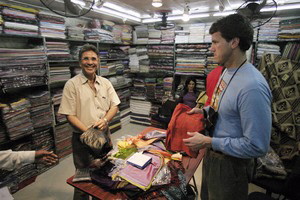
Guess who won?
Indians have founded more engineering and technology companies in the U.S. during the past decade than immigrants from Britain, China, Taiwan and Japan combined (Source: Where The Engineers Are, Vivek Wadhwa, 2007).
Incredible.
The entrepreneurial abilities of Indians in general has amazed me for years. It seems that Indian culture produces an uncommon blend of innovative thinking, business-minded aggression, and comfort with numbers. But there is another ingredient...
Two weeks ago, I saw a screening of the film 2 Million Minutes, a new comparative documentary that examines education in the US, China, and India. The filmmaker, Bob Compton, also wrote a book titled Blogging Through India, which I thumbed through before the movie.
Lo and behold, it contained this great little description on one of the greatest skills Indians bring to the table:
Negotiation.
In India, every transaction -- EVERY transaction -- is negotiated. Merchandise, cab fare, restaurant bills, wedding doweries -- the list is endless.
As our guide Vishnu explained, "In India, we bargain to the level of the individual vegetable purchase."
While awkward and uncomfortable to most Americans, that level of negotiating can be quite valuable.
Hotmail founder Sabeer Bhatia, a CA transplant from Bangalore, credited the bargaining skills he learned in vegetable markets at home for getting Microsoft to push its acquisition price for his company from $160 million to $400 million. Bill Gates' eye teeth were floating in tea with that deal.
Here are a few rules for bargaining on the buy-side when in India...
Rule #1 - The true price of any item is what you pay -- There are no suggested retail prices in India. Nothing is labeled, so it pays to talk with several vendors before making a significant purchase.
Rule # 2 - Try for 70% off -- Don't accept less than 30%
Rule # 3 - Make them show lots of merchandise -- If it is a rug merchant, you want the demo guys sweating profusely before you make your first offer. Get the vendor to "invest" in the transaction -- emotion, time and energy.
Rule # 4 - Offer on one item at a time - If you plan to buy a couple things DON'T let on at the outset. Act like you intend to buy only one item, if that much. Get the seller to give you prices on each item; play one item off another to show you are looking for the lower price point.
Rule # 5 - Wait for the pad of paper -- Every Indian sales person has a pad of paper and a pencil that they pull out when the bargaining gets a bit more serious. Though they write down the price for an item, this is only the starting point - remember rule #2.
Rule # 6 - Say "TOO HIGH", a lot - Don't even start negotiating until the salesman has scratched through the initial price and lowered it at least twice. I found that simply staring in silence at the pad of paper for a long time would result in the vendor cutting the price.
Rule # 7 - Imply a bundled purchase -- OK, now that the price has been cut 25-30%, ask the salesman what deal he would give you if you buy two items. Expect 5% off. Ask for three items; get another 5%. Then add a very expensive 4th item -- one which you do not intend to buy. This will excite the vendor and he will do a bunch of calculations which you will be unable to follow. The price will come down for the expensive item as well as for the other items you intend to buy. Lock those prices and drop the expensive item.
At this point, you should have been able to shave close to 50% off the initial price. Most Americans generally are satisfied at this point and close the deal.
One final point - no matter what price you pay -- if the sales guy is smiling when you leave -- guess who won...
Is it a stereotype that Indians are good at negotiating? Sure. Is it accurate? Just neglect to prepare next time you match wits against an Indian entrepreneur and you tell me.
Do you have your own negotiating strategies, tips, or stories? If so, please share in the comments, and feel free to build on or borrow from the recommendations in the 4HWW.
Related links:
How to Negotiate Luxury Treehouses and Convertibles
---
Timothy Ferriss is author of the new #1 NY Times bestseller and Amazon Top 10 Customer Favorite, The 4-Hour Workweek [http://www.amazon.com/gp/product/0307353133?ie=UTF8&tag=offsitoftimfe-20&linkCode=as2&camp=1789&creative=9325&creativeASIN=0307353133]
Follow Tim Ferriss on Twitter: www.twitter.com/timferriss
Want to reply to a comment? Hint: Click "Reply" at the bottom of the comment; after being approved your comment will appear directly underneath the comment you replied to
I think most of the other commenters here have missed the point and are thinking of this as a social policy instead of a personal skill.
We were asked to add our own insights. Here are a few.
In the areas in which I negotiate most frequently, I am both a buyer and seller in a reasonably small enough community wherein one can develop a reputation and where one may wish to have future dealings.
When I am a buyer, I make it a point to never tell the other that "it's not worth that" but rather only explain what I can justify paying for it. Making personal aspersions that the seller is asking beyond worth isn't helpful at that moment or for future negotiations. Point: never insult the seller or their price.
As buyer, I always try to keep the exchange positive so the seller is happy to have had the exchange. I will pay value for product of value and will seldom haggle the last penny out of a deal because I know the shoe will be on the other foot someday - future deals. I also know that I get deals brought to me specifically because I'm pleasant to deal with. (I have been told on many occasions that the seller has come to me first specifically because it would be a stress-free exchange.) In my dealings, getting first opportunity is very valuable.
Sometimes you just want to buy something and not pretend spending half a day haggling is your entertainment. Also it's bad enough standing in line behind an old person while they spend 15 minutes debating about the Quarter Pounder or the Big Mac. Haggling would add another 20 minutes to the process.
Now with this “Hunter/Hunted Mentality” we have understood the perspective of the Hunter, now lets discuss the perspective of the hunted.
Do I really want to make sure anyone who does business with me have a frown on his or her face when we are done?
Do I ever want the individual I purchase something from to ever service my purchase? Or worse, sabotage it so I can buy again, sooner.
How does a service economy (U.S. and India) survive with this mentality?
Now lets extrapolate this mentality into other aspects of our society. Will it really provide us with a better way of purchasing and selling all of our needs? How has it helped the societies where this way of life is the mainstream?
Did the Indian culture utilize this helpful art to negotiate, on behalf of their citizens, the best public water supply and delivery system to all their homes in Metro Areas? This is the 21st Century and they are apparently still negotiating this rudimentary public service. Is India really poorer than the U.S. was in the early 1900’s when the U.S. began building and paying for similar infrastructure? Or are they simply unwilling to pay the real and legitimate costs for what they desire.
Another troubling theme in all societies where the bazaar / negotiating mentality exists, is the need to negotiate all aspects of life in the society. It turns out in these societies, police services are negotiable, law enforcement is negotiable, land registration at the county clerks office is negotiable. And if you still don’t get it, the negotiations are known as bribes.
If something costs $50, than it costs $50! If I can afford it I buy it. If I can’t, I don’t.
If I am cutting it by 50%, I am going bankrupt!
But don’t worry; I will service it for 50% less than that other company will, at least while I am in Chapter 11!
as someone who prefers not to conduct business as though a devastating caste system were a healthy, normal part of life, i disagree that haggling some poor vendor is the highest and best use of a (comparatively) wealthy westerner's time and money.
being born into incredible privilege, in my opinion, as nearly all americans are, is an obligation, not an entitlement. we need to make good, conscious choices about spending and should look at the ethics behind a product when deciding how much to pay.
none of us hit triples - we were all born on third base. can we please humble ourselves for long enough to support hard-working, incredibly poor people?
The ritual of bargaining can be found as close as Mexico, if that's what you're interested in. If you have the time to spend and that means that your time must be worth more than it takes to acquire the equivalent in money--true in India and Mexico but not in the US--bargaining can make economic as well as playtime sense.
Those who bring the practice of bargaining to a situation where time is precious just waste everyone's time.
There's a difference between bargaining and closing a deal that gets lost from the perspective of only the buyer. Closing a deal--that is, being willing to actually sell something--is an art in itself. Gotta go with the flow or else we get beached.
You must be logged in to comment. Log in or connect with