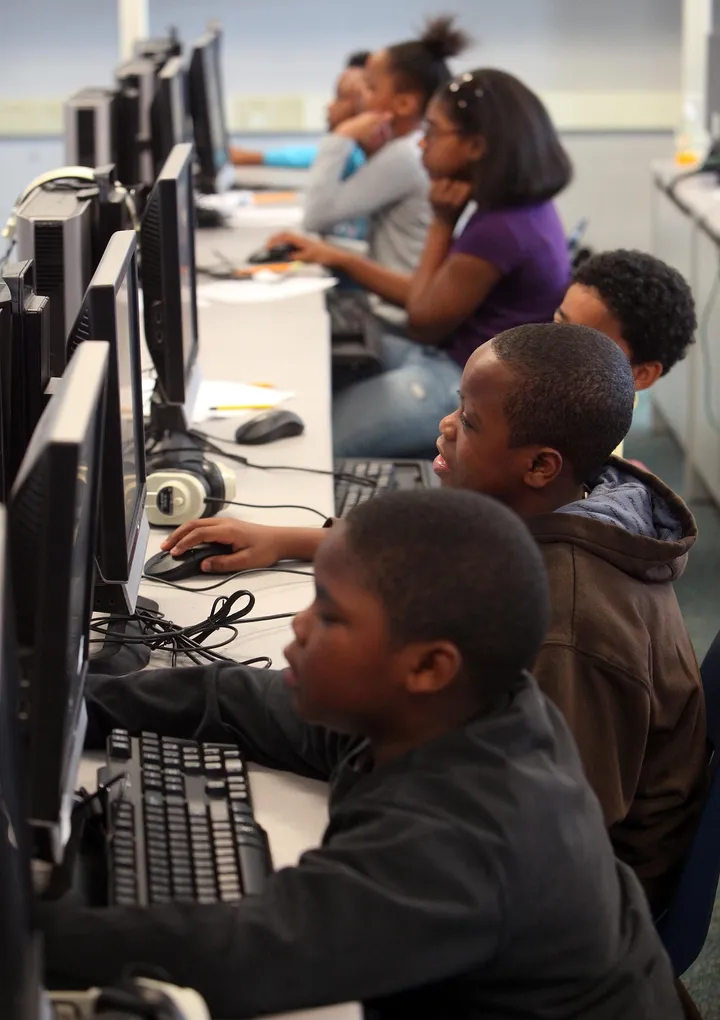
Digital learning will benefit all students -- particularly students from low-income families where education leaders are proactive. In light of the 'OER exacerbates the gap' flap this week, I thought it would be worth expanding on the ways in which EdTech, blended learning, and open education resources (OER) will benefit low-income kids. Following is a list of 10 ways that digital learning will benefit low-income students:
1. Good teachers. States that authorize multiple providers and allow part-time enrollment (like Florida, Idaho, and Utah) give every student access to great teachers in every subject.
Public Impact is building on the Innosight Institute report, The Rise of Blended Learning, and identifying strategies -- most using technology -- that extend the reach of great teachers. The net benefit is that five years from now more students will benefit from great teachers.
2.Good content. During the next five years most states and districts will shift to predominantly digital content -- it will be more to date, more engaging, and provide more expansive learning resources than print. The shift will disproportionately benefit low-income students that have had less access to quality content.
3. Diagnostics. Adaptive assessments and improved diagnostics are beginning to pinpoint learning levels and gaps that must be addressed. These tools -- like NWEA MAP, Wireless MClass -- are of particular benefit to students whose learning has not been well supported.
4. Special services. We're beginning to see the deployment of online services for students with language and learning difficulties. Available on demand, they often work better and are less expensive than traditional approaches.
5. More options. Personal digital learning is enabling a wide variety of school options -- some that blend online and onsite, and some that are purely virtual. Where states allow it, families have a wider variety of options to meet specific needs.
6. Advanced courses. Soon, most states will give every student access to every advanced math and science course, as well as Advanced Placement and college credit courses. With scaled providers it is logistically simple and very affordable to provide cost-effective access to consistent quality. This relatively new capability unquestionably benefits low-income students.
7. Time. As the high performing elementary Rocketship network is demonstrating, school models that blend digital learning with classroom instruction can extend the learning day for students that need an 8-hour school day to overcome an early childhood vocabulary deficit.
8. 24/7 access. Over the next five years, most schools will provide take home technology (at least for secondary students) that will extend access to learning resources around the clock. States, cities, and school districts will continue to make progress on extending access to broadband. The combination of devices and broadband will narrow the digital divide.
9. Free. There has been an explosion of free and open educational resources. With Khan Academy, every family has access to at least one great math teacher. Teachers can use social learning platform Edmodo, video sharing service SchoolTube, and math games from MangaHigh all for free (Learn Capital portfolio companies). Free content is helping schools make the shift to personal digital learning -- that's good for all kids but particularly for low-income students.
10. Culture. Good schools have a powerful culture of high expectations and strong support. As education shifts from a place to a service, social learning groups will extend a culture of learning beyond traditional classrooms. Teacher social networks are connecting subject area teachers across the country. Reducing the isolation of teachers and students and promoting a college/career ready culture will disproportionately benefit low-income students.
Digital learning won't close the achievement gap, but it will lift the floor. More students will be more academically successful. Five years from now, a higher percentage of students will soon graduate from high school ready for college and careers. Most will have benefited from Common Core expectations. Some will have benefited from Race to the Top funded programs. Many will have benefited from these 10 reasons that digital learning will benefit low-income students.
Follow Tom Vander Ark on Twitter: www.twitter.com/tvanderark
Tom Vander Ark: 2011 Was an Inflection Point for Digital Learning
Tom Vander Ark: Questions About Digital Learning
White House details plans for more digital learning - USA Today
I do not expect online / digital learning to add much value for disaffected students.
The Physics education research (PER) has shown dramatically that it is possible to achieve much higer gain routinely by changing the method of instruction. But it does not require a large amount of advanced technology. Everyone is looking for the quick fix, but there is no substitute for well trained respected teachers. Look at Finland which achieves excellent results with little homework, no high stakes testing, and less time in class.
OFTEN THE CLASSROOMS DON'T HAVE INTERNET ACCESS, ANCIENT COMPUTERS, NO COMPUTERS, NO SOFTWARE AND REGULAR SUPPLIES LIKE PENCILS ARE DIFFICULT TO GET. IN MY CLASSROOM, I HAVE A MYRIAD OF CHALLENGES IN ADDITION TO THE LACK OF SUPPLIES, SOFTWARE/HARDWARE. THERE IS A DESERT IN THE HEARTS OF CHILDREN THAT FACE A DECAYING COMMUNITY THAT IS STRUGGLING TO STAY VITAL AND INNOVATIVE. THE ADULT ILLITERACY RATE, CRIME, BLIGHT PEPPER THE CITY, FAMILIES ARE FIGHTING TO KEEP THEIR HOMES AND JOBS ARE MANIFESTED IN THE CHILDREN THAT COME TO MY CLASSROOM EVERYDAY. WE NEED REAL VOLUNTEERS THAT WANT TO HELP ALL YEAR ROUND BECAUSE A COMPUTER CANNOT WIPE THE TEARS AWAY FROM A HOMELESS CHILD NOR CAN A CANDY CANE AT CHRISTMASTIME FILL A HEART WITH OPTIMISM OR HOPE. I AM USING WHATEVER PROGRAM, EQUIPMENT AND RESOURCES AVAILABLE TO ME. IT TAKES A VILLAGE TO RAISE A CHILD. THAT'S NOT A SLOGAN, IT IS ESSENTIAL TO PREPARE OUR STUDENTS FOR A GLOBAL COMMUNITY. BRING YOUR KNOWLEDGE AND ENTHUSIASM BECAUSE WE NEED ALL OF YOU! PLEASE GIVE ME THE RESOURCES AND SUPPORT. JUST DO IT!
http://www.amazon.com/Getting-Smart-Digital-Learning-Changing/dp/1118007239/ref=sr_1_1?ie=UTF8&qid=1317680732&sr=8-1
I know something about how learning takes place, and the Habits of Mind, that enable it. The 'disadvantage' is not that they lack a computer. It is that they lack an environment that develops the HABITS OF MIND that leads to learning and literacy.
It is obvious that Tom has never taught low income or disadvantaged children. Does he expect the parents of low income children to build these habits and skills? Tom undervalues the actual work a teacher does.
There is GENUINE research that outlines the NECESSITIES for the brain to acquire both SKILLS and INFORMATION (2 different things) whichis LEARNING. The REAL standards research was done by Harvard on the EIGHT PRINCIPLES OF LEARNING. It takes the entire conversation out of the realm of OPINION, validating the things that must be in place to develop the crucial HABITS OF MIND that result in that acquisition, AND the ability to APPLY SKILLS AND KNOWLEDGE.
Motivating students, helping them to organize time to learn and to practice -- TO APPLY what they learn IS WHAT TEACHERS DO. The profession of pedagogy is so poorly understood, that the media and the business dollars that support e-education is able to publish such nonsense.
As for emerging economies, while online education can be cheaper than actual education (or else the people who invest in it and those paid to shill for them wouldn't be pushing it so hard), that assumes a first-world infrastructure that those emerging economies lack. It'd be both cheaper AND more effective to send them teachers.
Online education has a legitimate place, but it's MUCH more limited than you'd have us believe. Mostly, it can be used as a second-best option for motivated kids who want to take a class that, because of low interest, isn't economically feasible for schools to offer. They can also be a second-best option for kids who, because of illness or injury, can't attend school. But they're definitely a second-best option, at best, and really only effective at all with highly motivated kids.
The middle class student with her own room, computer, and college educated parents who work in a profession will still have an overwhelming advantage against the child who shares her room with siblings and has to do the housework or work parttime to help keep the family going.
I launched Fluke - the wealth building game of accidental inventions is a board game where players enter into the wild, wild world of intellectual property, Corporate America. Corporations hire a fleet of lawyers to fight and protect their ideas with patents, trademarks and copyrights as it is the core of their financial wealth. The game exposes players to patents of real life generic named patents with their history on the rear of each patent replica. Players buy, sell and license patents. They also buy and sell research corporations with emerging technology. The player with the largest portfolio of patents, research corporations and cash wins. http://www.xconomy.com/detroit/2011/12/23/a-detroit-moms-quest-to-breathe-innovation-into-young-minds/2/
This game should be racing through Urban America. It is moving faster in suburban communities all over the country. http://www.youtube.com/watch?v=zIykAFoA4EI
The statement, "Teacher social networks are connecting subject area teachers across the country" understates the global collaborative revolution that digital learning is fueling right now to the benefit of low-income students here and abroad.
Here is a sample, graduate research from Michelle Lee Johnson, "Latino High School Student Cross-Cultural Collaborative Learning Utilizing Global Technology," Pepperdine University, 2011
http://www.scribd.com/doc/60682121/Cross-Cultural-Collaborative-Learning
Teachers connecting across the world will increasingly benefit low-income students.
I've watched the Edmodo community grow to more than 500,000 teachers over the last two years and am impressed and inspired by the collaboration we see across the network.