
BRÅVIKEN BAY, Sweden -- A worker at the Kolmården Wildlife Park in Sweden's Östergötland district was killed on Sunday by a pack of wolves. Kolmården, the largest wildlife park in the Nordic region, located 150 kilometers south of Stockholm, attracts some 500,000 visitors each year to its attractions that include Tiger World, dolphinarium and a drive-through safari park.
According to sources, the deceased, a 30-year-old woman, entered the wolf enclosure at roughly 11 a.m. Her body was later recovered by a team of rescue workers including an armed park official.
Said a spokesperson for the Ostergotland police, "We do not know why they attacked."
Says me, "Because they're wolves."
Whereas the typical 30-year-old zookeeper is a nearly hairless biped with no claws or fangs, the typical wolf is 85 pounds of muscle and sinew armed with interlocking two-inch canines. Wolves can run 40 miles an hour and can bring down prey as large as a musk ox. Wolves have no natural predators and in a pack they can best virtually anything on dry land. Wolves are also wild animals, wild carnivores to be precise, and as to why they would attack a virtually defenseless woman, I refer you to common sense, fairy tales and basic animal psychology.
I will almost certainly never be attacked by wolves. That's because I live in a city and I don't go where wolves go. I also don't go in the Gulf of Mexico. That's where sharks live. Every year about this time I start hearing about this, that or the other poor sap who got bitten by a shark in the Gulf of Mexico. I'm tired of hearing those stories. Tell me a guy got bitten by a shark in my neighborhood and that would be news. A guy getting bitten by a shark in the Gulf of Mexico, that's foreseeable.
Whether it's a woman in the suburbs getting mauled by a chimp, or an illusionist getting torn up by his own tiger or an Australian getting run through by a sting ray, stories of wild animals killing people who get too close are not the sorts of stories that make me say "wow." They make me say "duh." Animals are very good at what they do or they wouldn't have made it through the process of natural selection, let alone the spread of humanity across the earth. If what an animal does is kill things, then unless it's a very small animal, I don't get close to it.
Take whales.
I know it's common these days to think that whales are some gnostic peace-bringers. The Sea Shepherds, the Ocean Conservancy and Leonard Nimoy, among others, want us to believe that whales have an important cosmic lesson for us. They probably do have a lesson for us and that lesson is: Don't go swimming around with things that weigh 60 tons. I know they have elaborate forms of communication and big brains, but just because a whale can sing doesn't make it Cass Elliot. A whale can kill you quicker than you can say, "Holy crap it's a wha... "
Wolves too. You are not Little Red Riding Hood and there is no huntsman nigh. You have no business messing around with wolves. Animal Planet will show you all the wolves you could ever wish to see without you even having to leave your couch. So you can leave the wolves where they belong -- with the whales and sharks and sting rays and chimpanzees and the rest of the world's deadly beasts -- on television.
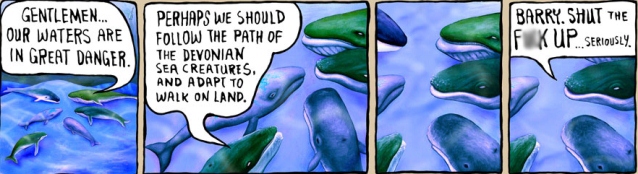
Courtesy of Nicholas Gurewitch, The Perry Bible Fellowship.