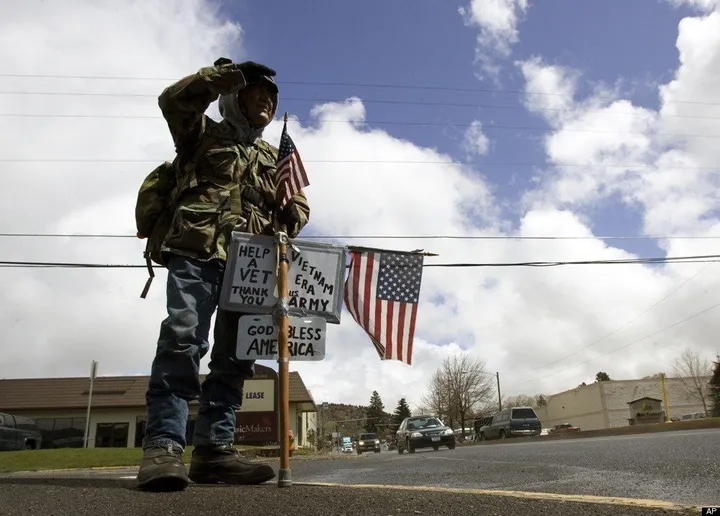
It appears the Veteran's Administration has been flying under the radar when it comes to their contribution to the homeless veteran population. Due to a backlog in processing thousands of disability claims, military members and their families are forced to live on the streets because of foreclosures and are heading into bankruptcy courts at an alarming rate.
Most of the wounded veterans I know have waited more than six months to get their first disability check from the VA after leaving the military. By the time they got their first payment from the VA, they were bankrupt or had lost their home to foreclosure.
Once that happens, they can expect to have ruined credit for seven to 10 years, thus preventing them from buying or renting an adequate home ever again.
It is actually against the law to foreclose on a home of a servicemember for up to nine months after they leave active duty.
I recently wrote about JP Morgan-Chase wrongly foreclosing on military mortgage holders' homes when they violated military consumer protection laws that date back to the Civil War. There was no excuse for Chase to ignore the laws that have been in place for decades.
Unlike some big banks, the VA does know better. They just haven't been caught yet.
And, unlike the backlog for disability claims, the VA has had no apparent backlog on processing foreclosures for VA-backed loans. Within three months of a medical discharge from active duty, the VA has stepped in to evict multiple wounded veterans and their families.
In one case, the VA disability file of a Fort Carson soldier sat untouched for six months. This file contained a form that stated his rating should be expedited because of his hardship. Even so, nothing had even been started on his file for six entire months.
Three months into his waiting process, the VA bought his home from Bank of America for about $100,000 less than the fair market value.
Last week, the VA sent him eviction papers giving him until the following Monday to move his family of six, including a newborn, out of the home.
The Servicemember's Civil Relief Act mandates that this military family is protected from foreclosure, but the VA apparently doesn't care. They just acquired their home for a steal of a price while sitting on his VA disability claim. Why should they care?
This Fort Carson soldier is not an isolated case. His next door neighbor was also evicted through the VA foreclosure process within six months of leaving active duty, and by then they were already living with their in-laws while they waited for the first VA check to arrive.
Now meet Ben Wisenbaugh, another veteran who is a VA casualty:
Ben's disability claim was delayed for so long that he was forced into bankruptcy. Due to his ruined credit from the lack of a VA disability income, he was unable to obtain a home loan through the VA. Using what little funds he had left, he and his wife bought a substandard trailer to house his family. His home was purchased for the equivalent of one to two months worth of a middle-class mortgage payment.
He is now getting assistance through our nonprofit, Cleaning for Heroes, to bring his substandard housing up to livable standards. I am the Executive Director of this organization, so I can say that Ben is just one of many veterans who come to us in a similar situation.
The Fort Carson soldier is also a Cleaning for Heroes client. However, he is prematurely leaving our program because he will no longer have a home.
And I am not happy about this.
After my husband testified before Congress regarding the Walter Reed Scandal, we were promised that changes would be made. Promises to "swiftly" improve or fix the system made the headlines. The formation of the Warrior Transition Units and a "streamlined" process between the DoD and the VA were a step in the right direction.
Back in 2007, there were case managers available to help with filing Social Security claims prior to leaving the military, and newly hired case managers at the VA would stay on top of each veteran's needs. Beyond that, new changes like the legislation that was passed -- that I had personally introduced and brought to the attention of my Congressman -- would help to resolve the issues of damaged credit resulting from the financial hardships incurred during the recovery process.
I no longer see any adequate evidence of those changes in 2011.
The Department of Veterans Affairs recently approved $50 million in grant funding to support housing stability programs with a focus to reduce the homeless veteran population.
I say they ought to start by putting the foreclosures on hold for at least nine months, and put more focus on processing the disability backlogs, don't you?
Author's Note: If you are a military member experiencing problems with foreclosure or any other consumer issue, please visit my favorite resource for reputable attorneys who can help you assert your rights as a military consumer: www.naca.net.
Author's update: Please be aware that as of February 2011 I am no longer associated with the Cleaning for Heroes program. In March 2011 a rountable to discuss strategies on veteran homelessness was discussed during the The American Legion's 51st annual Washington Conference. John Driscoll of the National Coalition for Homeless Veterans said the number of homeless veterans has dropped from about 250,000 in 2004 to 76,000 today. According to National Coalition for Homeless Veteran's website, the number of homeless veterans exceeded 106,000 in the last CHALENG Report data. To see the full report, click here.
I have since published information exposing the VA's reaction to this article by the Public Relations Team.