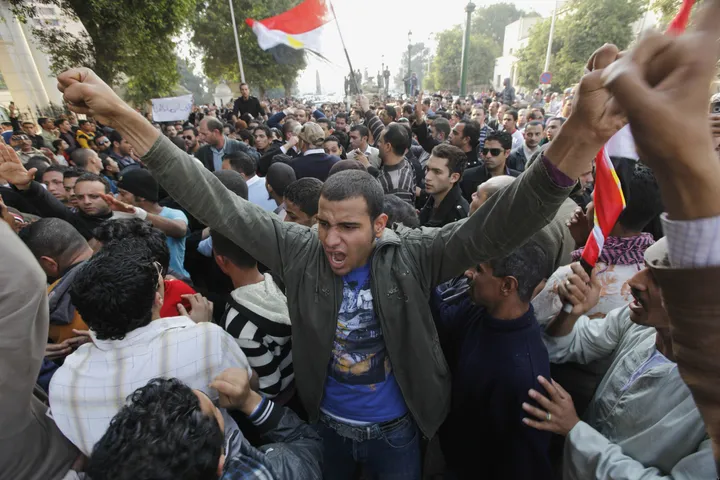
The Arab world is witnessing a revolution. After decades of apathy and repression, Arab citizens are finally rising up against ossified, undemocratic regimes that have been backed by the West. Whereas the Tunisian revolution caught the United States--and much of the Arab world--by surprise, it is clear that the events unfolding in Egypt have been of much greater concern to the Obama administration.
The awkward, hesitant response on the part of U.S. officials to the events on the ground has been startling. President Obama may have belatedly accepted Hosni Mubarak's departure, but he did so only after it was clear that millions of Egyptians would settle for nothing less. The difference in the open, enthusiastic American embrace and support for Iranian protesters in 2009--or the anti-communist revolutions that swept Eastern Europe two decades ago--and the American scramble to salvage the status quo in the Arab world is nothing short of stark.
Why is the United States afraid of Arab democracy?
The answer is that in large part the outrage of the people being expressed on the streets is more than a revolution in Arab affairs. Although they are unquestionably first and foremost a revolt against unpopular and illegitimate governments and the economic and political despair these governments have engendered, the mass protests are also a revolt against American foreign policy itself. For decades, successive U.S. Republican and Democratic administrations have supported repressive Arab regimes in the name of the "stability" of a strategic, oil-rich region. This discourse of stability rationalized repression of Arab citizens. It isn't that American diplomats, intelligence agencies and officials have not known about the torture and disenfranchisement rampant across the Middle East. They have known, and, as the secret rendition program illustrates, many among them have been prepared to exploit this sordid reality in the name of protecting U.S. interests. The United States has assumed that Arab voices, desires, aspirations, and fears are inconsequential to its hegemony over the region.
The peace process is an obvious case in point. Unlike Saudi Arabia, Egypt is not an important economic ally of the U.S. But it has been a crucial client state that is at the heart of normalizing Arab relations with Israel. One of the most notable refrains of American commentators and officials concerned with events in Egypt is not the lack of democracy in Egypt, but the fear that Egypt's peace treaty with Israel would be jeopardized by a popular revolution. Yet most Americans don't realize that the American peace process has been dependent on oppressive Arab regimes. The Egyptian-Israeli peace treaty of 1979, like the Jordanian-Israeli treaty that followed in 1994, was negotiated by Arab autocrats--Anwar Sadat and King Hussein respectively. They may have delivered cold peace with Israel, but the quid pro quo of these treaties was the acquiescence to Israeli colonialism in the West Bank and East Jerusalem. The presidential term of U.S-backed Mahmoud Abbas expired in 2009. Yet his Palestinian Authority continues to be heavily subsidized by the United States. Hamas, by contrast, actually won the Palestinian elections in 2006. The U.S. refused to recognize the outcome, and instead has worked actively with Israel and the Palestinian Authority to undermine the results of that democratic election.
Certainly, Egyptians today are not focused on Palestine but on their own country. They want freedom, not war. But Egyptians are also part of the Arab world. They may no longer accept, for example, to have their government participate in the terrible siege of Gaza.
The emergence of new democratic movements in the Arab world will demand accountability from Arab rulers; but they are just as likely to demand a new approach to the peace process. For decades, U.S.-led "peace" making has been based exclusively on Israel's security concerns and its internal politics, on whittling away Palestinian rights, and on denying the real political significance of an overwhelming Arab sense of injustice at Zionist colonialism in Palestine.
In the meantime, the struggle for freedom in the Arab world will likely only get more desperate. As events in Egypt have demonstrated, Arab autocrats will not abdicate willingly. But ordinary people insist on real change. Mubarak's sudden downfall is a testament to the strength of a human desire for dignity. Because its hegemony in the Middle East has been so unpopular, the United States may soon have to confront a day of reckoning when Arabs finally achieve their democratic rights.
The irony is that the idea of self-determination began with an American president, Woodrow Wilson. Yet this idea has been systematically betrayed by the US in the Middle East since 1947. 2011 may well mark the beginning of the end of corrupt Arab regimes. And with the fall of these regimes there will be an opportunity to build not only a free Arab world, but an American foreign policy that supports this powerful current, and not, as it has done for decades, stand in its way.