iPhone app iPad app Android phone app Android tablet app More

Featuring fresh takes and real-time analysis from HuffPost's signature lineup of contributors
Valarie Kaur

GET UPDATES FROM Valarie Kaur
 

10 Sikh Women You Should Know and Why You Should Know Them

Posted: 03/22/2012 8:08 am

If you ask a Sikh about their religion, the first thing you will hear is belief in the Oneness of God. The second is that Sikh men wear turbans to cover their long hair, an article of faith which tragically became a target after 9/11 (See, I just did it). But if you linger a minute longer, you will hear us beam about the equality of women in our faith. Unlike in most other religions, our scriptures are explicit about women as equal in the eyes of God.

What if you asked for names of famous Sikh women? You will hear a short pause. Then, a slight effort in concentration, before: Ah ha! There's Mata Tripta, the mother of the first Guru! And Mata Nanki, the sister of the first Guru! And Mata Khivi, wasn't she the second Guru's wife? You will hear an earful of mothers, sisters, and wives of the Ten Gurus, or teachers of the Sikh faith in the 15th and 16th centuries. As the list ends there, you may begin to sense there is something amiss.

It's time to confront the gap between our ideals and how we live them.

Sikhs Americans like me talk a great deal about women's equality, but we are steeped in an old patriarchal culture that makes us complicit in the erasure of women, past and present. Even the few famous women in our history are defined in relation to their men. Their full contributions as thinkers, poets and warriors unto themselves are eclipsed by the men they supported. The real life consequence? Sikh girls today are told they're fully equal, and yet many are expected to carry out traditional gender roles -- with few role models to suggest otherwise.

We would never tell you this, of course. You can't blame us. There are so few of us, it's hard to air our community's problems -- especially after 9/11, when explaining that "Sikhism" is a religion in the first place became a matter of daily survival. In fact, as a third-generation Sikh American activist, it took me nearly a decade after 9/11 even to begin talking about women again. After the terrorist attacks, we women tacitly agreed to put our issues on hold. We needed to protect our men first -- our brothers and husbands and sons whose turbans and dark skin marked them as primary targets for hate in the years after 9/11.

This was a mistake. As we waited (and are still waiting) for the discrimination to pass over us, some of the cultural dysfunctions in our community worsened. Women are girls are always the first casualties within minority communities under siege. That is no different in ours. Just as in most patriarchal traditions around the world, the bodies of women have been considered vessels of honor in Punjabi culture. When riots and massacre swept Punjab during the 1947 Partition of India, some Sikh men poisoned their daughters before letting them fall into the hands of Muslim rioters. Today in America, while many Sikh families champion education and freedom for sons and daughters alike, others have tightened control over women and girls in the 9/11 decade. In the worst anecdotes, domestic violence is an outlet for men who bear racism on the street, intermarriage an act of betrayal, and honor killings an actual threat.

But there's another story too. The call for liberation pulses through the Sikh tradition: it's in our scriptures and songs and stories. Hearing the call, a new generation of Sikh women has emerged as lawyers, artists, entrepreneurs, doctors, filmmakers and more. They have found brave new ways to defend their communities while offering their own unique voices to public discourse. I am proud to call them my contemporaries -- they are sources of inspiration, wisdom and leadership in their communities who deserve to be known.

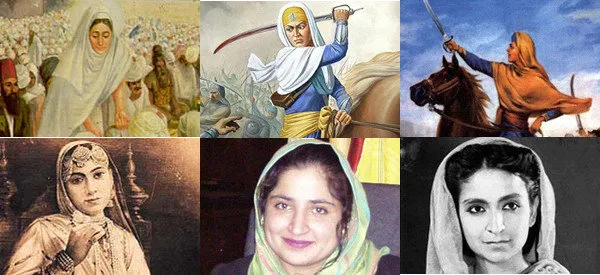
Here are 10 Sikh women who embody the highest Sikh ideal of the warrior-saint. Half are legends from early history -- women who we will never fully know but whose deeds ignite our imagination as the first female warrior-saints. Half are modern-day heroines -- each one stands for hundreds of Sikh women who are blazing their own paths as the warrior-saints of our era.

My hope is that the next time you ask a Sikh on the street about their religion, they will be able to name all these women. And you will already know their names.

Loading Slideshow...
  • Mata Nanaki (1464-1518)

    The First Sikh Born in Chahal village (now Lahore, Pakistan), Mata Nanaki loved and nurtured her younger brother Nanak. In 1469, Nanak experienced a divine vision as a young man and became the first Guru or "teacher" of what is now the Sikh faith. Mata Nanaki was the first to follow him and should be celebrated as the first Sikh, which literally means "disciple" or "seeker of truth."

  • Mata Khivi (1506-1582)

    The First to Serve Langar Mata Khivi followed Guru Nanak and prepared food for all who came to hear the Guru's spiritual discourse. When her husband became the second Sikh guru, Guru Angad, she presided over <em>langar</em>, a free and open kitchen, serving food to rich and poor of all castes and backgrounds. Today, every Sikh <em>gurdwara</em> in the world serves <em>langar</em> to the community.

  • Mai Bhago (Late 1600s - Early 1700s)

    The Fearless Warrior-Saint Born in Jhabal village (now Amritsar, Punjab in India), Mai Bhago grew up in a time when the 10th guru, Guru Gobind Singh, fought to defend Sikhs against Mughal forces and hill chiefs. During a great siege in 1705, Mai Bhago rallied 40 deserters and led them into battle herself, sword in hand. They died fighting and became known as the Chali Mukte, the Forty Liberated Ones. Afterward, Mai Bhago became the Guru's bodyguard, donning a turban and cross-dressing in male warrior attire. Today, she is revered as a saint.

  • Rani Sada Kaur (1762-1832)

    The First Woman Commander-in-Chief Rani Sada Kaur became a young widow when her husband was killed in a battle among Punjabi chiefdoms. She used the moment to transform herself into a woman-warrior, donning a high turban and weaponry. She commanded battles and laid the foundation for the Sikh empire, which spanned the Punjab from 1799 to 1849. She closely advised her son-in-law as he became the first Maharaja of the new empire, Maharaja Ranjit Singh.

  • Maharani Jind Kaur (1817-1863)

    The First Female Freedom Fighter Married to Maharaja Ranjit Singh, Jind Kaur was Maharani of the Sikh empire -- and the first female freedom fighter in the struggle to oust the British from India. After Ranjit Singh's death, the British annexed the Punjab through bribery and battle. Rani Jinda Kaur's revolutionary speeches and writings rattled the British who imprisoned her in Punjab, Nepal, Calcutta and finally, England, where she died in 1863 at the age of 46. She is credited for sowing the seeds of India's struggle for independence.

  • Amrita Pritam (1919 - 2005)

    The Great Poetess The leading 20th century poet of the Punjabi language, Amrita Pritam is considered the Sikh community's unsung heroine. She is the first prominent woman Punjabi poet, novelist, and essayist, equally loved on both sides of the India-Pakistan border. With a career spanning six decades, Amrita Pritam produced more than 100 books. She represents the rise of Sikh women in the humanities -- writers, artists, filmmakers, and scholars.

  • Dr. Inderjit Kaur (1942 - )

    The Fierce Social Worker A doctor by training, Inderjit Kaur is the President of the <em>Pingalwara</em> Charitable Society in Amritsar, Punjab in India -- a famous home open to the poor, handicapped, diseased, and mentally ill. Since 1992, she has carried the legacy of its founder Bhagat Puran Singh with her own bold leadership. She stands in for countless Sikh women -- doctors, nurses, health-care advocates, volunteers -- who care for the sick and poor.

  • Prakash Kaur (1951 - )

    The Champion for Girls In a state infamous for female infanticide, Prakash Kaur runs a house in Jalandhar, Punjab for 60 abandoned girls. She was abandoned herself -- found a few hours old in a drain. Since 1993, she has rescued and raised unwanted and unclaimed newborn girls. She represents the many Sikh women fighting for women and girls against abandonment, domestic violence, sexual assault, and forced marriage.

  • Amrit Singh (1969 - )

    The Civil Rights Lawyer A formidable civil rights lawyer, Amrit Singh was one of the fiercest U.S. critics of the torture and abuse of prisoners under the Bush Administration. As an ACLU attorney, she litigated cases on torture, indefinite detention, and post-9/11 discrimination. She now serves at the Open Society Justice Initiative. Her father is the 13th and current Prime Minister of India, Manmohan Singh. Amrit Singh represents a new generation of Sikh women lawyers, wielding the law as sword and shield in the battlefield.

  • Dr. Anarkali Kaur Honaryar (1984 - )

    The Senator Arnkali Kaur is a human rights advocate and Senator in Afghanistan. As one of 3,000 Sikhs and Hindus in Afghanistan, she fights for the civil rights of minorities and women. When the Taliban was overthrown in 2001, she joined the Grand Council, Loya Jirga, to elect the interim government, and then helped draft the country's new constitution. She serves as the first non-Muslim woman member in the lower house of parliament. In 2009, at 25 years old, she was voted "Person of the Year" by Radio Free Europe's Afghan chapter, becoming a household name in Kabul. A modern-day "Mai Bhago," Arnakali Kaur represents the rise of brave modern-day Sikh women warriors.


Follow Valarie Kaur on Twitter: www.twitter.com/valariekaur

FOLLOW RELIGION
If you ask a Sikh about their religion, the first thing you will hear is belief in the Oneness of God. The second is that Sikh men wear turbans to cover their long hair, an article of faith which trag...
 
 
  • Comments
  • 23
  • Pending Comments
  • 0
  • View FAQ
Comments are closed for this entry
View All
Favorites
Recency  | 
Popularity
Page: 1 2  Next ›  Last »  (2 total)
02:15 AM on 04/21/2012
I have one thing to say that Still our people have not made SIKHISM popular worldwide. Identity confusion remains between sikhs and the terrorists.. Even most of Europeans do not know about SIKHS and the almost stare at a sikh when they see him I personally has felt this.

Can our leaders not take up an awareness campaign for SIKHISM worldwide which will help to present our religion and all people know about SIKHS and understand their religions and other details like long hair, turban etc etc... Even in country like China which is neighbor to INDIA they do not understand much of SIKHS... S I feel AWARENESS CAMPAIGN WORLDWIDE SHOULD BE TAKEN AND this should be done in every country and in its every city...
11:17 PM on 04/07/2012
The term in Sikhism is "saint-warrior" or "saint-soldier" translated from "sant-sapahi". Saint comes first on purpose - one is to become a saint and know the truth before one knows what to fight for. I wonder why you reversed the order in your article.
03:35 PM on 03/29/2012
Excellent article! One of the things that struck me while I did research and published my thesis on the Hindustani Ghadar Party was the absence of women's voice in fighting for freedom. Again, I loved your article!
HUFFPOST SUPER USER
mono
09:42 PM on 03/28/2012
In 1400 AD there was a cult (Google BHAKTI cult) in India where some Hindus (Guru Nanak, Guru Angad, Guru Arjun, Guru Ramdas. etc) denounced the practice of Hinduism and at the same time some Muslims (Bulleh Shah, Baba Farid, Shah Hussain etc.) denounced Islam and whence Sikhism evolved.
Therefore, Sikhism is subset of Hinduism and Islam. The holy book is compilation of these gurus words in the form of poetry. There are 10 gurus that Sikhs believe in and except the last one, Guru Govind Singh none of their Gurus name ends with SINGH which is the proof that they were all Hindus. The religion never really thrived excepts only in one province of India because it had it's own idiosyncrasies and shortcomings and now the very existence is at stake as many Sikhs are converting to Christianity. Men started keeping short hair which is against the edict of Sikhism, changing names like the author of this article who changed her name to VALARIE, inter-racial marriages like Nikki (Randhawa) Haley, the Governor of South Carolina.
Therefore, I say what good the names of the good Sikh women does when the very ethos of the religion is fading, slowly?
10:41 PM on 04/12/2012
Every Religion has its beginning as a cult. Even Jesus was born in a Jewish family.
Sikhism is based on its own principles which might have similarities from other religions but certainly cannot be called a subset of those religions.
The fact ia all Gurus have denounced many of the practices of Islam and Hinduism.

The fact that that only Guru Gobind Singh ji has the name that ends in SINGH is because he gave us this identity. During the Baisakhi of 1699 when he formed the Khalsa Panth and gave the edict that every Sikh male shall have SINGH.

When you say "... it had it's own idiosyncrasies and shortcomings.." can you even prove point? And to the fact Sikhism doesn't believe in forced conversions the number of Sikhs is ever growing.
There will always be some people who don't follow the path of religion and live their life on their own principles ... You cant judge the whole community seeking an example of them.

About Author its her personal choice whatever first name she wants to keep however the important fact your missed is her last name... KAUR... which signifies everything.

The Ethos of Sikh religion are very strong and in no manner fading. They have been tested by time many times over in history, we have maintained our identity during the most turbulent times in history. We have always succeeded with the Guru's Grace and shall continue to do that.

-Jasdeep Singh
02:42 AM on 03/24/2012
Really nice article. I really enjoyed it.
07:49 PM on 03/23/2012
Dear Valerie,

I like the spirit behind your article--I think! But the broad strokes you feel entitled to make about the community, are quite disturbing to me, as a Sikh woman, who keeps identity, has not married outside faith, and works directly with violence against women personally and professionally, and has never been threatened (even if challenged) by the community for activism. We have way more role models and a way deeper understanding about gender in our community, than you let on. There are issues. Serious ones. Ones that Sikh women and men are actively dealing with. Like any other community, gender discrimination remains culturally embedded. For us, as Sikhs, it is a matter of great security that at least our faith believes in our equality and our anti-violence work. Many women I work with gain strength from our faith, and see no trouble in separating Punjabi culture or American culture for that matter (remember Chris Brown for example?) from the Sikh faith. I wish you wouldn't over-simply. And I wish you'd do less outside-in, ethnocentric viewing that has become all too common post 9/11. Thank you for highlighting 10 wonderful Kaurs, including Bebe Nanaki. But we have way more than 10, and let no one think differently!
photo
ZenSufi
Sisters and Brothers of America!
02:28 PM on 03/23/2012
Where's Nikki Haley?
12:40 AM on 03/27/2012
Populating a list of Sikh women you'd rather not know?
06:55 AM on 03/28/2012
Not on this list for sure.
pamela18335
Ignorance can be fixed; stupid is incurable
12:55 PM on 03/23/2012
Thank you so much for this article and for educating us about Sikh women, past and present. You've inspired me to do some research on my own, as I know very little about the Sikh religion, and would now like to know more.

Until we all learn to appreciate the diversity of our world, we will never be at peace in it.
12:21 AM on 03/23/2012
Where is my freedom of expression and speech?
12:19 AM on 03/23/2012
Why are my comments disappearing? Are you Indian? Are my comments disappearing like the disappeared in Punjab?
This user has chosen to opt out of the Badges program
09:23 PM on 03/22/2012
interesting; glad you were able to include modern examples as well as past legends
07:21 PM on 03/22/2012
Thank you for this.
05:38 PM on 03/22/2012
I have read the article...since it is on the topic of equality of women within sikhi. My question is why aren't they allowed to do kirtan, or sit in side the Darbar sahib( aka Golden temple).? Where is the equality in that?...I am a meek sikh of Satguru Guru Granth sahib ji, and I am presenting this question humbly to ponder upon...and maybe bring change. Because as of right now, sikhi is different for a male and female, a girl can never hope to do kirtan in Darbar sahib...is this fair?

humbly,
11:52 AM on 03/23/2012
Unfortunately, Punjabi culture and Sikhism conflict in almost every way. Traditonally, men have always been the ones to do kirtan, however neither the Guru Granth Sahib nor any of the Gurus said that women could not do kirtan. In fact, the Gurus encouraged women to do so. I have seen more and more women do kirtan here in Canada and if you look at the white-Sikhs in New Mexico, they practice equality of men and women in the gurdwara well. In my opinion, the Akal Takht has it all wrong and I believe it will change in this generation.
photo
HUFFPOST SUPER USER
joncavanaugh
I am, and forever remain, at your service.
05:02 PM on 03/22/2012
I LOVE articles like this!
02:49 PM on 03/22/2012
Do you know any poetry or other artistic/literary works by Amrita Pritam on the 1980s-90s oppression of Sikhs in India?