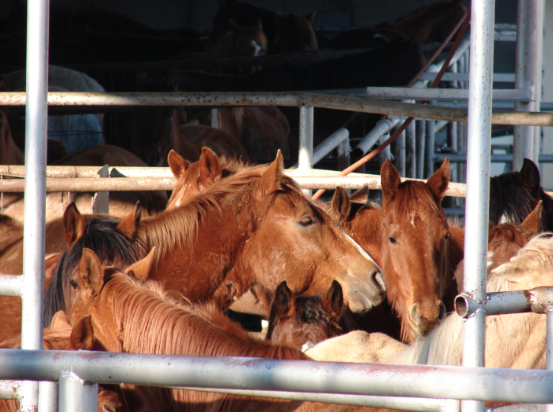
The proposed slaughterhouse brought hope to the struggling rural town of Rockville, MO.
Widely publicized as the first U.S. facility to slaughter horses after a five-year ban on inspections ended last year, the plant would provide 50 jobs according to its chief proponent, Wyoming state representative and horse-slaughter lobbyist, Sue Wallis.
"It will open by summer's end," Ms. Wallis has declared in dozens of news reports over the last month.
Except it won't.
For starters, neither Sue Wallis nor her business partner has filed for the required permits with the Missouri Department of Natural Resources or with the Missouri Department of Agriculture.
You can't operate a slaughter plant without them and they can take months to process. Further, with the U.S. Congress once again considering a ban on funding USDA inspections of horse meat in 2013, inspections at the Rockville plant -- or any horse slaughter plant, for that matter -- are highly uncertain.
Perhaps a bigger obstacle, though is that Ms. Wallis and her business partner -- Missouri attorney, Dan Erdel -- do not own the plant she claims to be retrofitting for a September opening. Nor are they capable of purchasing it legally, thanks to civil and criminal charges arising out of a questionable deed of trust issued through a shell company named Six Bears and its owners and operators, Canadian Vincent Paletta and his wife Diana.
Paletta had already been charged with two counts of felony stealing by deception when Wallis' announcement brought the plant to the attention of Mountain Grove attorney Cynthia MacPherson. It was MacPherson who uncovered the elaborate plan by the Palettas to protect the plant from creditors. (A comprehensive report on MacPherson's findings has been issued by The Equine Welfare Alliance).
On behalf of one creditor, Elvin's Refrigeration, MacPherson has sued the Palettas, asking the court to block all transfers of the property until the ownership can be determined and creditors protected. The petition claims the Palettas violated MUFTA (the Missouri Uniform Financial Transactions Act).
Elvin's has also filed a Nonconsensual Common Law Lien against the plant's owner charging that the Palettas fraudulently used bogus deeds of trust and even sued themselves through their shell companies to protect their assets from creditors.
Sue Wallis and Dan Erdel -- along with the two companies they formed to ostensibly own and operate the Rockville plant -- are unlikely to do either.
This would be Wallis' second failed attempt to slaughter horses in Missouri. Her previous proposal to the citizens of Mountain Grove (where MacPherson has her law practice) ended badly. Word has it they ran Wallis out of town.
Undeterred, Ms. Wallis has already proclaimed Oklahoma as the next place she will attempt to slaughter horses--despite a state law making it illegal to sell horse meat or possess horse meat for sale.
Perhaps someone should alert the media before they report that, too. So far, it's been slow to recognize Wallis' habit of counting chickens -- and slaughter plants -- she cannot hatch.
Vickery Eckhoff's writing has appeared in The New York Times, The Wall Street Journal, The New Yorker and Forbes. Her 11-part series for Forbes.com exposes predatory practices in horse racing and the U.S. horse industry, with a focus on the political, food-safety, humane, environmental and economic impact of horse slaughter.
Best regards,
Paula Bacon
Mayor, Kaufman,TX
2003-07
http://www.vetsforequinewelfare.org/white_paper.php
Horse Slaughter –
Its Ethical Impact and Subsequent Response of the Veterinary Profession
A White Paper
Prepared by
Veterinarians for Equine Welfare
Horse slaughter does not provide a humane service for “unwanted” horses
The entire argument that horses that go to slaughter are unwanted is unfounded. Instead, the horse slaughter industry exists solely because a profit stands to be made in fulfilling gourmet demand in foreign countries for horseflesh. Where there is a market demand it will be supplied by market forces, in this case by unscrupulous companies and individuals who stand to profit off the slaughter of American horses. For example, when the three remaining horse slaughter plants were operating in the US, Cavel International imported horses from Canada for slaughter in order to fill their demand.
Horse Slaughter –
Its Ethical Impact and Subsequent Response of the Veterinary Profession
A White Paper
Horse Slaughter is not humane euthanasia
It is the united opinion of VEW that horse slaughter is inhumane, and that it is an unacceptable way to end a horse's life under any circumstance. One need only observe horse slaughter to see that it is a far cry from genuine humane euthanasia. From the transport of horses on inappropriate conveyances for long periods of time without food, water or rest to the very ugly slaughter process in which horses react with pain and fear, no evidence exists to support the claim that horse slaughter is a form of humane euthanasia. Rather, it is a brutal process that results in very tangible and easily observable equine suffering.
Transport of horses to slaughter compounds equine suffering
Despite the presence of federal regulations governing the transport of horses to slaughter,[1] horses continue to suffer immeasurably en route to slaughter. Current regulations are paltry, allowing for horses to be transported for more than 24 hours without food, water or rest. Heavily pregnant mares can be moved to slaughter, as can horses with broken limbs or who are blind in one eye. Further, the regulations only cover the final leg of the journey, so slaughter-bound horses moved from auction to feedlot, for instance, are not covered by the rule.
This horse slaughter industry is filled with deception and fraud and the horses are suffering and paying the price. It is all about the money. Nothing about it is good for the horses and definately not about what is good for the humans eating them. Perhaps Wallis' plan was never to really to slaughter horses especially since they were all closed here and the writing is already on the wall. Maybe she's just trying to enable a scam and swindle her alleged partners like all the mortgage fraud scandals that have plagued the U.S.in the last several years - and apparently she can't do that right either...
http://cloudshorsetackblog.com/
Personally, I don’t think there’s an easy fix to this problem, for example, just look at all the dogs and cats at animal shelters,here in United States, that are euthanized because no one gives them a home. Not the best solution there. Unwanted horses that are a financial liability to take care of are not much different than the dogs and cats in animal shelters.
Orville
Your articles are so well-written & correct - unusual these days.
Maggie
From Jerry Finch’s HABITAT FOR HORSES:
http://habitatforhorses.wordpress.com/2012/07/17/horsemeat-and-drugs/
Horsemeat and Drugs
17Jul
What they DON’T want you to know…
This article has been a major collaborative effort. Within these pages you will find absolute, scientific proof that horse meat from the US is deadly. To dispute these facts is to deny any role that science plays in research of the effects of chemicals on the human body. For those in the US, this tells of why a Federal system once concerned about food safety decided to bend the rules to benefit a few foreign companies. For those in the horse meat eating countries, read closely, for this will tell you why you are not feeling well at all. While long and detailed, this knowledge is vital to those wanting to know the truth about horsemeat and drugs.
Tatoos and chips will not protect your horses. These thieves were very well organized and this will happen again.
Just say no to horse slaughter.
I absolutely refuse to go through that again. Say NO to slaughter!