iPhone app iPad app Android phone app Android tablet app More

Featuring fresh takes and real-time analysis from HuffPost's signature lineup of contributors
Vicki B. Escarra

GET UPDATES FROM Vicki B. Escarra
 

When We Feed Children, We Feed Our Future

Posted: 06/10/2012 11:30 am

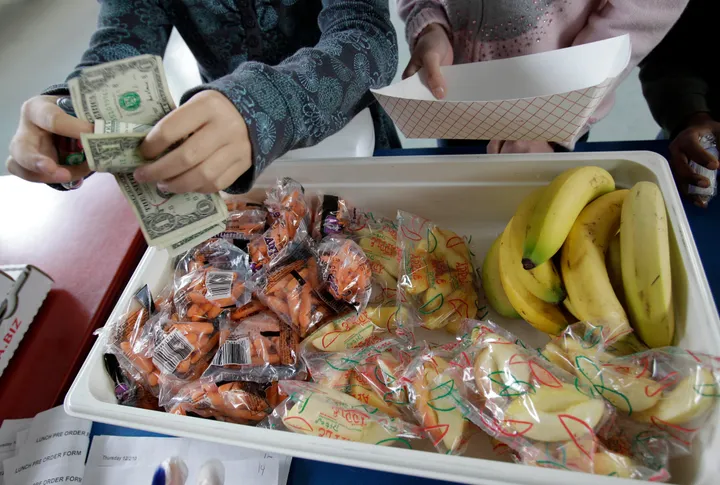
There are 16 million children in the United States who are facing hunger. How many of those kids live in your community? How many of those kids live right next door?

A study released earlier this month by Feeding America, called Map the Meal Gap: Child Food Insecurity 2012, gives people the unique opportunity to see how many children face hunger in their community.

The findings are troubling. Unfortunately, there is not a single community in the United States that is free of child hunger. Hunger continues to exist in every county and every congressional district in the nation--even the wealthiest.

That means in places like Santa Barbara County, Calif., a place that is synonymous with upscale vineyards and posh resorts, there are children who do not get enough to eat. In fact, in spite of the luxury associated with that area, nearly one in four children in Santa Barbara County are food insecure.

And in some places -- places that you may never have heard of -- it's even worse. Places where the unemployment hasn't rebounded and tens of thousands of people are out of work. Places like Zavala County, Texas, where almost 50 percent of the children are facing hunger. That means almost half of that county's children aren't getting enough to eat.

It's unthinkable that somewhere in this great country, in these modern times, there is a place where almost half of the kids go hungry.

Child hunger is a serious problem in this nation. We know that hunger can fundamentally alter the trajectory of a child's life. Studies show that hunger affects a child's physical, cognitive and behavioral development. From birth to age 3, chronic under-nutrition is most harmful because proper nourishment is essential to support this critical period of rapid growth. And workers who experience even periodic hunger in childhood may not be as well prepared physically, mentally, emotionally or socially to perform effectively in the contemporary workforce, resulting in a less-competitive worker pool. Workers who experience hunger are more likely to experience health issues that force them to take more sick days to care for themselves or their children.

And the problem is not going to get better for low-income children. As Congress works to balance the budget and reduce our national deficit, the federal nutrition programs that help families cope with a weakened economy are at risk of sever funding cuts--and at a time when the need for those programs are needed more than ever.

Right now, the Farm Bill, which authorizes the funding for critical programs that feed children and adults like SNAP, TEFAP and CSFP, is moving through the Senate. Unfortunately, those programs are at grave risk of budget cuts that would essentially gut the programs, leaving millions of families without the help they need to feed their families.

With children facing hunger in every county and every congressional district in the country, our nation cannot afford to strip away the safety-net that keeps them from going hungry. We must send a message to Congress that they have a responsibility to protect our nation's children.

I urge you to contact your Members of Congress and tell them that they need to protect the programs that help feed our nation's children. Visit the Hunger Action Center and send a message to your elected officials today.

You can also join Feeding America, Rep. Jim McGovern (MA) and other hunger advocates on Monday, June 18 at 1:30 EDT for an important virtual town hall meeting about how we can work together to ensure Congress passes a Farm Bill that puts us on the path to a hunger-free America. Register to join the conversation.

To see how many children face hunger in your community, visit www.feedingamerica.org. Please also share this 90 second video about the child food-insecurity with your community.

Child hunger has serious implications for our nation. If we want a prosperous future for America, we must make sure that our future generation has the food they need to grow and thrive today.


Follow Vicki B. Escarra on Twitter: www.twitter.com/vickiescarra

FOLLOW IMPACT
There are 16 million children in the United States who a...
 
 
  • Comments
  • 8
  • Pending Comments
  • 0
  • View FAQ
Comments are closed for this entry
View All
Favorites
Recency  | 
Popularity
06:27 PM on 06/11/2012
What about the children of the working family that does not qualify for any of these programs.

Our social programs have done nothing to improve the literacy rate, decrease the crime rate, or increase the incentive to get off these free programs.

For instance - the students that receive FREE school lunches, snacks, and perhaps breakfast and dinner - what are they learning ? They are learning that they get everything for free as long as they "qualify" for these programs. Where is the incentive to "not qualify" and actually have to make your own PBJ sandwiches, or perhaps learn to budget. Perhaps even, to learn that one should not have babies before they are financially able to provide for them.
This user has chosen to opt out of the Badges program
photo
VictoryBlue
Motorcycle rider, Legalization supporter, Texan
12:10 PM on 06/12/2012
So we should blame the kids? Kids in elementary school don't understand the concept of free food. They only understand that they get to eat with the rest of their class. By your mindset though, we should force them to go hungry, let them die then we don't have to care for them later in prison? Or would you prefer that we take them away from their parents? THen the state has to raise them, which it has not been very successful at that. Of course, if we elminate all social programs, what do you think will happen? What is your take on it? Are all those people suppose to go out and get jobs where none exist?
12:38 PM on 06/12/2012
When I was in school, I learned that eating in the cafeteria was a special event, done only when my single mother had the money to spend for it. Otherwise, I learned that school lunches were packed in either a lunch box or a brown paper bag and made by my mother. It was a "big girl" thing to make my own Peanut butter sandwich and go to the store and pick out the bread that I wanted it on. I learned that I having the "flying saucer" cookie was a special treat, not something to be taken for granted.

I learned that my mother had a job, had to pay for everything, as there were no social programs in place. And, she did a great job. She had the number of children that she and my dad could take care of. She became a widow after my dad came back from the war and did a great job raising me.

Yes, perhaps women would make different choices if they knew that they had to take care of the kids that they birthed rather than expecting others to do it for them.

The argument that you make has been used for generations, and now we see the impact of that philosophy. When one reaches the age of 18, and is about to lose their monthly welfare benefits, they have kids of their own and the cycle continues.

What ideas do you have that would make a difference ?
06:20 PM on 06/11/2012
This belief has proven to cost billions, maybe trillions in social programs that do nothing more than encourage those who cannot support their own children to have more.

Look at the statistics regarding children of families that receive FREE everything. low motivation, low income, low english skills, low literacy, high crime, high birthrate, high dependence on government programs.

Perhaps if we let the "children of mass producers" go hungry, then that would be a warning to others to NOT do the same.
03:56 PM on 06/10/2012
What about feeding the elderly? Meals on Wheels? I hate how America forgets the people who help build this country!!!!
photo
HUFFPOST SUPER USER
Care 2 Blare
goodness&mercy 4 US
06:54 PM on 06/10/2012
Your 1st Fan :-) agree with you on such a great program Meals On wheels provides not only needed and most appreciative meals to the elderly, but some socialization also.