
There are two types of fashion designers: those who can draw drape cut and sew and those who can't, but they know everybody -- they are well-connected! I call the latter, "vanity designers." They have an idea of how people should look, their own idea, but they need to hire designers who can draw drape cut and sew so their name can be on clothing and they will matter.
The exhibition at the Met, "Conversations Between Schiaperelli and Prada," was just the latter; two vanity designers having a conversation about their influence in fashion. They both could have used better patterns.
Before I went to the show I asked my Parsons classmate designer-artist, Mary Alice Orito, what she thought of the show, and her comments were identical to the ladies who sat next to me in the self help dining room (where BTW the delicious fresh food salad bar was a highlight). Quite remarkably, my two out-of-town table neighbors had the SAME comments as the old pro:
1. This exhibit was such a letdown after the extraordinary Alexander McQueen exhibition in both display and beauty. (McQueen was a trained Savile Row tailor and theatrical.)
2. There was nothing of the 'anti-pretty' of Prada they would want to wear... nothing!
3. Maybe this show is our historic moment... with artist and designers redefining 'pretty' by once again taking away the feminine? Our current world doesn't do pretty. Pretty is weak, pretty is decorative, pretty doesn't define, pretty becomes a different illusion of stretching artistic viewpoint by dumbing down or deconstructing to the point of ugly?
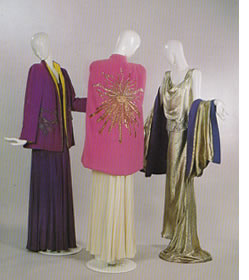 I said I loved and would wear the Schiaparelli velvet cape with the golden sequined sunburst in the back. The women looked at me, as their lifestyle didn't warrant gold sunburst velvet capes. I told them I had actually copied the idea in the '70s when Paris had a Schiaperelli show at the Musee de la Mode and I fell in love with her knee length cape. I did it in navy blue silk velvet but instead I had a 4 inch wide green sequin dragon wind around the back. My dragon even had a long red beaded tongue. I made it as a gift for Elizabeth Taylor, but I don't think she ever wore it as I saw it one day on the back of her teenage son Michael.
When I arrived in Paris to open my shop in 1964 my partner Mia Fonssagrives fell in love and married a proper French Faubourg St Honore couturier, Louis Feraud. Louis had his ateliers on the small street around the corner. There were 20 tiny maids rooms of sewers on the fifth floor. They were divided into two distinct groups; Flou and Tailleur... Draped and Tailored, and you could not be both! You were either!
Flou were all women; French, Tunisian, Spanish and Portuguese, who draped, beaded, and crocheted textured surfaces. The tailors were men, mostly Italians and British (where the best suits came from). They knew the art of facing and ironing so surfaces lie flat. They could make collars roll!
Both Elsa Schaiparelli and Miucchi Prada were trained in their brains, not their fingers. Neither were schooled or trained as couturiers. Both came from Italian Royalty; Elsa, a countess and Miucchi, the daughter of Prada; a classic handbag fashion house. Both had insider friends in the art and press world and yet they both contributed "Some New Things" to the fashion world. Chanel once called Schiaperelli "the Artist who makes Dresses."
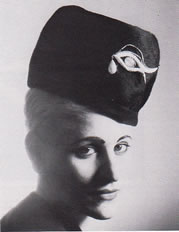 Schiaparelli gave us, the Hat with the shoe on the head, the lobster on the dress and the Surreal accessory. Her serous contributions were the poly dress and bolero and the block printed knit! She was the first to put visible zippers in dresses, the first to use a lot of hot pink. I own her Shocking pink perfume bottle, a woman's torso, (before Jean Paul Gauthier's), done by Dali. Her artist pals like Dali and Giacometti helped her to get noticed. Chanel earlier in the twenties invented knits, and the knit cardigan we still wear today. She also, by the way, invented sportswear.
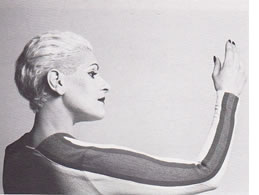 Prada gave us dresses, also in the same work-plastics as the Prada bags. These bags were the first $3,000 plastic bag that should retail for a tenth the price except for the 90 percent markup for the metal triangle that says "Prada." Today's tailored Prada clothing have arty appliques to the masculine tailored clothing. These dresses could stand on their own without a body inside. The body is superfluous. The minimalist garment is the statement, not you!
The Conversation Exhibit was too tightly packed together and the dresses were too forced to be seen up-close. The sewing was often very bad. Both designers designed for the ideal tall slim hipped woman with no breasts. I think Wallis Simpson and the stern thin red lips and a no frills hairdo.The one and only sexy cut bustier dress could have used McQueen's training to spot a nipple point in the wrong place.
The exhibit was not packed as the public knows a good show. God bless him, sadly, Alexander McQueen is a hard act to follow.
VICKY TIEL began designing clothes 40 years ago in Paris and still owns a boutique there, as well as dedicated mini-boutiques in Bergdorf Goodman and Neiman Marcus. In fall 2010 she launched a line of cocktail dresses and special occasion wear sold through department stores nationwide. Her memoir, IT'S ALL ABOUT THE DRESS: What I Learned in 40 Years about Men, Women, Sex, and Fashion was published by St. Martin's Press in August 2011.