My dear friend Pancho is just thankful by nature. One time, after one of his thank-yous, I responded back in his native Spanish with, "De nada. Isn't that how you say you're welcome?"
"Well, 'de nada' means it's nothing,'" he explained, "so, what you probably want to say is 'con mucho gusto', meaning with much pleasure."
I paused for a second. Initially, it seemed like it was just semantics, but then I realized that there's a significant difference in the two. By saying that it's not a big deal, the emphasis is on not wanting the other person to feel that it was a burden in any way. I'd be downplaying my own role, but I would also not be acknowledging the conscious intention in my action. Instead, when I express my genuine pleasure, there is an implicit recognition of what I'd received through the experience.
It's an important distinction, and one that points to an easily accessible, universal experience: The simple gift of connection. It can come from the simplest of opportunities. Shortly after getting married my wife made a rule that every time we crossed a toll bridge we would anonymously pay for the person behind us. As soon as we'd paid the toll, we would drive away. Then, from the rear view mirror, we'd watch for the confused hand lingering outside the next car's window, eventually pulling back with their toll money. Zooming off, we'd invariably feel like gleeful little kids.
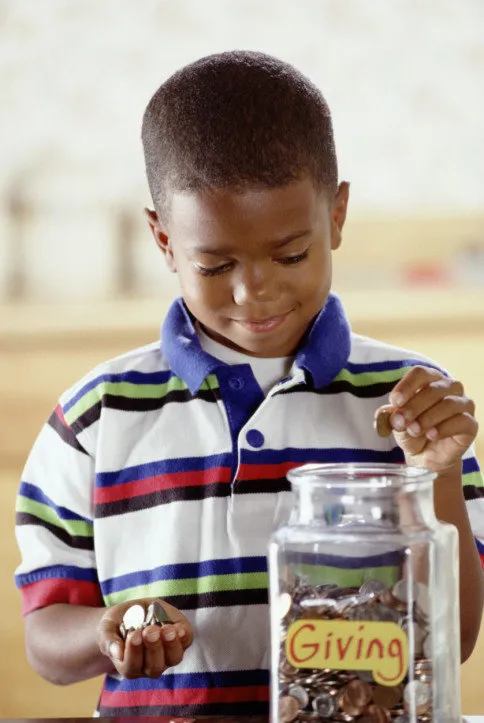
In the increasingly inter-connected world that we live in, we have many chances to tune in to this fundamental joy of giving. It comes down to nurturing that intent to do good for someone else, and then being aware of what impact it has on us. By being awake to the joy that comes from serving someone, we are transforming both the act and the actor. As the Dalai Lama puts it, "If you want others to be happy, practice compassion. If you want to be happy, practice compassion." It sounds paradoxical, that the most generous act there is -- compassion -- actually benefits us. It all depends on how we define self, and how that definition arises.
At a subtle level, there is a panoply of activity inside: our attitudes, perspectives, habits, beliefs, intuition, etc., and more broadly, our thoughts and emotions. These mental objects themselves don't arise in a vacuum. What I think and feel is a product of all of my past mental and emotional actions. Something like 90 percent of our thoughts are just repeated thoughts. And then, my response to it all is dictated by both the momentum of my own mental tendencies, as well as some degree of choice. At every instant, our identity forms from this smorgasbord.
In this process, our choices move along a spectrum of self-orientation which on one end lies habitual selfishness, where we just follow the dictates of unconscious patterns of interpretation and reaction. In the words of the mystic scientist Albert Einstein: "We experience ourselves, our thoughts and feelings as something separate from the rest. A kind of optical delusion of consciousness. This delusion is a kind of prison for us, restricting us to our personal desires and to affection for a few persons nearest to us." But how can we break out of this prison?
We can engage on the other end of the spectrum, where the self-ishness is conscious. Here too, there is an unflagging inward attention, but there is also tremendous choice. This choice allows us to watch all of those habituated patterns come to the surface, and then not get sucked into the maelstrom of its momentum. This kind of sustained observation of the inner experience has its own effect: It allows us to become aware of the constant, real-time feedback we receive from all that we do. We experience things, places, people, situations -- all of life -- through the prism of our own minds, and each experience reverberates back to us. If we give it the space, we can literally feel our connection to everything else.
So even when I do something as simple as paying for someone else's bridge-toll, I immediately register the impact of a "helper's high" -- a rush of endorphins produced in the brain, equivalent to a mild dose of morphine. But that high isn't the end, in and of itself. More importantly, that feedback allows me to acknowledge a connection to that person, and in so doing, my self-definition can then include that connection. And so, awareness feeds compassion: Anytime I engage with a sincere inclination to do something good for someone else, I wake up to a greater connectedness.
The opposite pattern, though, is strong. But with every effort towards generosity, I dissolve my own tendency to remain rigidly self-confined. For even that one moment, I go from a small definition of self -- a me-orientation -- to a consciously-chosen, broader identity. And then compassion feeds awareness: In the process of giving lies my own evolution. In the words of the visionary surgeon Dr. G. Venkataswamy, who personally restored sight to 100,000 people with his own two hands, "When we grow in spiritual consciousness, we identify with all that is in the world -- there is no exploitation. It is ourselves we're helping, it is ourselves we're healing."
In moving from habitual selfishness to a conscious selfishness, the paradox unravels: To be truly selfish is to be generous. Con mucho gusto -- with much pleasure, indeed.