
Alex Perry has told many stories, like the time he was banged up in a Zimbabwe prison or when he witnessed the first American deaths in Afghanistan in 2002.
But it is one of the new buzz words in the dictionary -- globalization -- that finally led Perry, Time magazine's Africa bureau chief to write his first book Falling off the Edge: Globalization, World Peace and Other Lies.
In the book -- written with the lightness of touch but journalistic rigor that is evident in his Time reporting -- Perry uses his experiences as a foreign correspondent in Asia and Africa to weigh up the new market theories that tell us that globalization is inevitable, universally beneficial... and y'all love it, just you wait.
"I actually resisted finding a central theme to draw from my experiences for a long time. I distrust neat, unifying themes -- if they're neat, and about the world, they almost have to be wrong because the world is such a diverse, messy place," Alex Perry told the Huffington Post.
Despite this initial reluctance, Perry said that when reporting on the explosion of crime and disenfranchisement, the worsening of pollution and spread of disease, and the impending climate disaster and diseases, he started to believe that most could be traced back to an unguarded enthusiasm for globalization.
"I couldn't help notice striking similarities between disparate conflicts -- all the more striking for how disparate and geographically separate those wars were. And those similarities had to do with the basic dynamics of conflict -- inequality, alienation, frustrated expectations, the crushing of individual identity in the name of a global standardization, the perception of imperialism, and victimhood."
<
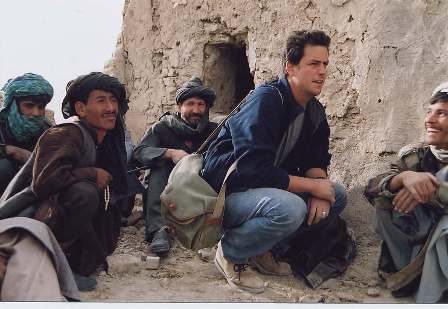
Alex Perry at Qala-i-Jangi fort, northern Afghanistan. Photo credit: Damien Delgueldre.
Most compelling is Perry's argument that the terrorist movements of the last twenty years stem from creeping globalization. He told the Huffington Post:
"Globalization is capitalism -- and capitalism is human nature. The problem with globalization is that it is unregulated capitalism -- we don't have global regulators. So globalization is capitalism out of control. [W]ars are started just as much by perceived slights and injuries as real ones. I don't think that al Qaeda is right that the US is trying to wipe Islam off the face of the earth, for instance. But many Islamists do believe that. And in that case, reality becomes less important than perceived reality. It doesn't really matter that al Qaeda is wrong about being a cornered victim, fighting for the survival of Islam. They believe that. And they've killed thousands in that belief. And that, then, becomes the point."
Globalization promoters (and the West) see themselves as actively support the notion of "freedom to" while the anti-globalization activists (which Perry says, includes Islamists and the Euro left) are more about "freedom from." Perry says that essentially the globalization has a large 'optimism versus pessimism' aspect to it.
"The advocates of globalization see themselves as liberating the world. They're giving the world democracy and capitalism -- freedom, in other words. What's more free than a free for all? And you would see it like that if your idea of your place in the world was defined by dominance, and patrician benevolence -- if you saw yourself as a super-power, in other words. The great frustration you see written on Cheney's face when he's asked about Iraq was because in Iraq, the administration, in Cheney's perception, was being nice. It was liberating people. It was solving terrorism by freeing the world. If these people had no more reasons to be angry, the administration's argument went, terrorism would stop. And that's a brave and bold idea. Laudable. And reasonably sound too. The trouble was in its implementation," says Perry.
"You don't free people at the point of a gun. It just doesn't work. The person on the other end doesn't feel free. He feels oppressed. Invaded. Occupied. Distinctly un-free, in fact. And that segues into the mindset in many parts of the world that are not dominant, that are not powerful, that are not super-powers -- that they are victims and pawns in an iniquitous world order over which they have no control. They see freedom as an absence of something -- often the absence of oppressive government, and often also the absence super-power interference and influence. Invading their country, armed to the teeth, killing civilians -- well that's the most extreme cause of interference you can get. And it confirms the victim world view: they are, plainly, oppressed by the big, bad bullies who run the world."
For all the reservations Perry says he's not anti-globalization.
"I don't think any reasonable or realistic person can be. Again, globalization just is. Being anti-globalization is like being anti-life. You can't do it; rather, the thing to do is to understand it better, and thereby make it more bearable for those at the bottom."
Falling off the Edge: Globalization, World Peace and Other Lies. (published by Bloomsbury and available through Macmillan in the UK from January 31).
If you have any questions or comments for Alex Perry, please leave them below.
MOSCOW — Presidents Barack Obama and Dmitry...
(AP) TEGUCIGALPA, Honduras — Ousted President Manuel...
HAPPY FOURTH OF JULY! The American flag has been painted on bathing...
After a long flight, the first family touched down in...
The first lady's garb is a great way to gauge what's hot for summer style. Michelle...
I wish Hunter S. Thompson had lived to see this. As Hunter said, "When the going gets weird, the...
Anyone who is in any way surprised by Sarah Palin's announcement today that she will...
Reporters are beginning to piece together an explanation for Sarah Palin's...
Michelle Obama traded the traditional red, white, and blue for Saturday's 4th of...
I'm liveblogging the latest Iran election fallout. Email me with any news or thoughts, or follow me...
The Cruise family is down under at the moment, and Sunday Tom, Katie and Suri went to the stage production...
During his interview with ABC's This Week on Sunday, Vice President Joe Biden made...
Andy Samberg, Joy Behar, Eddie Izzard, Denis Leary,...
It's been amusing to observe, in the past few days, Sarah Palin hit the media...
A long weekend, parties, crazy hats, fireworks, and fun...
DENVER — Casket makers catering to natural burials have offered biodegradable coffins made of...
Want to reply to a comment? Hint: Click "Reply" at the bottom of the comment; after being approved your comment will appear directly underneath the comment you replied to
On the one hand, we do indeed live in a global economy ... linked by a global information network that will whisk my words around the world (if the moderators duly consent).
On the other hand, we also live in a world that is poisoned by the notion of "super power," as well as by human-nature itself. It is programmed into our genes to dominate, to excel, and to kill. It may be impossible for a nation to be "generous" without being "patrician." Nothing is given to you, but that something else is required of you.
And so, we trade. And trade, if done properly, matches the collective strengths of the various participants against each other to produce outcomes that can be amazing. But "trade, done properly," is also against human nature. We want to live off the fat of the world, but not to soil our hands with it.
For the past fifty-odd years, the United States of America in particular has sought to spread its military influences far and wide, and its "money" even farther, to have the rest of the world support it in the manner to which its leaders would like to become accustomed. Much of this is only the work of a few thousand people in key positions, who would happily be an inherited plutocracy (and consider the same to be their rightful due) if allowed. But this is a dead-end course for the 305 million ordinary people who now live here.
Sundialsvc4 -- I've nothing to add to that, except: it sounds like you have (or already have had) a book in you too. What a great and erudite discourse we're having here. Really. It almost makes writing a book worth it, just for this.
See Virginia M. Moncrieff's Profile
Thanks Alex for being part of this lively discussion.
The word globalization really has no distinct meaning. It is a lie at best. The world has always had global trade IE: globalization was in effect. What is the difference. Very simple. Today it simply means multinationals rule the world. This is bad news. Companies exist to make profits. They are not there to take care of your needs. Think about it. Think about it very deeply.
I think you are partly right - it is about multinationals being able toe xtend into markets where before they couldn't, and why wouldn't they. Like Bhopal, where they just did what they want - but whose fault it is ...... the multinational or the government eager to get the money and not so eager to care for its citizens?
Alex Perry, when you discussion invasion and the fact that Cheney is confused because he thought he was delivering freedom, do you think it's the same with people like MOnsanto who think they are delivering freedom as well as profits for themselves.
Thank you for this post. Very relevant.
Cylindar -- you're right that globalization is a new word, but the phenomenon is as old almost as life itself. (See post below on interviewing a Stone Age man at the start of the book.)
Wasim -- As I said, I think there wasn't a lot wrong with the administration's ideas of how to solve terrorism. It was the implementation that was completely wrong. Nor is there much wrong with a multinational pharmaceutical or agri-bio concern delivering their products to the developing world -- that in itself, if they are good products that alleviate suffering and promote prosperity, is a good thing. It's a question of how they do it. I don't know enough about Monsanto to comment with authority, although I've heard all the allegations about tying farmers to a particular variety of seed with debt, and have followed the Frankenstein crop debate. But I do know an example of a big pharma company delivering to the developing world -- Merck, in Botswana, where Merck has funded and supplied the entire HIV/AIDS treatment program. Infection rates are coming down from some of the highest in Africa, infectees are living normal lives, and one of the reasons the program is efficient and well-run is that it is run by a business which demands results, rather than a charity, many of whom do not.
You make the point below that globalization is capitalism without regulation. Anti-globalists would argue that capitalism itself is unregulated greed and not able to be 'reigned' in sufficiently to be structured and regulated. Capitalism has always been proudly SURVIVAL OF THE FITTEST ever since the word and notion were invented.
If you are arguing that globalization is capitalism unbound, then we are in real trouble, because the more i see of capitalism, the more i think it is not actually the answer except for the top 10%. But I don't know what is!
Sounds like a book I need to read. Thanks.
Sure -- some of the anti-globalization crowd would argue we need to replace capitalism completely with benign state-run socialism. That's a big argument, one that's been going on for centuries, but one that I'm only skirting here. In Falling Off The Edge, I'm concentrating more on finding out what is happening in the world, rather than imagining possible better future worlds -- simply because I became convinced that what is happening was widely misrepresented and misunderstood.
As for capitalism today, we are living in a period when it is relatively unbound (as opposed to, say, the 1940s to the 1970s). It'll be interesting to see whether the current downturn, precipitated by the extreme end of poorly regulated globalization, will produce a reaction and swing in the other direction. My gut says not.
I am really interested in this issue you raise as i think that capitalism (all that free market rah-rah) is really a western idea and not necessarily human nature as Virginia says. How do you feel about the idea that religion formulates your world view? Islam for eg is almost socialist in its world view.
I think religion can. I'm not on on very sure ground when discussing the relationship between Christianity, specifically Calvinism, and capitalism, but I'm prepared to allow for that, and intuitively it sounds eminently possible.
But Islam, you're right, can be very socialist in its world view -- and it's striking that the first generation of political Islamists modeled themselves very much along Marxist lines. The second generation, what we have now, tended to go with a millenarian, nihilist, cosmic struggle which placed more emphasis on victimhood and martyrdom -- which to some extent can be seen as an extension of that kind of socialist view, in that it starts from the same basic premise -- exploitation -- but instead of having a revolution to do make a better life, prefers a war to hurt the other guy and celebrate defiance. The best example I know of the close relationship between Islam and socialism is in the southern Philippines, where the rebels split into Marxist and Islamist factions in the late 1970s, but cooperate to this day.
alex your book sounds really great. i will check amazon for it : ) thanks for writing about this important topic.
Armistice -- cheers. Happy reading.
Great Postt...Who said we were reasonable, at this stage of the game. For thirty years we have watched this cancer proceed, all over the world. The heart of man is not ready for globalization, we're too greedy. Your right it dosen't work. Where were you, when the world was in self destruct mode, when things could be turned around. Poverty doesn't call on just the desenfrancised, it will be for the majority. This hellish global quest, when we weren't spiritualy able too manage our own house, led in large part to the down fall of many nations. We need a miracle, and it better come soon.
You know, one of the reactions I get from some readers is that they find the book really depressing. That surprised me. First, because I guess I was concentrating primarily on getting my facts right, reporting, reporting, reporting, rather than the impact they might have.
But also because over the years of reporting conflict,I've come to realize that war is generally far less depressing -- and shocking and horrifying -- than we imagine. Yes, it can be all those things. Death is awful, mass death is unbearable, and people can do some truly unimaginable things to each other. But that's far from everything that happens in a war zone. Very often, it's a place where most people go on living as best they can. Even the idea of a war 'zone' is often misplaced: New York, London, Madrid and Bali are all war zones, if you define them strictly as places of conflict. But nobody would think that a good description for any of them. I guess what I'm saying is that war and conflict is all around, it's a part of us, and much more a part of our lives than we generally allow ourselves to believe. So, so the line goes, love is all around too. At any rate, I've always found war zones less depressing than people imagined from the outside.
Alex, your book sounds cool. I'm gonna check it out. I have a few questions
You make a good point about India's budget/population v Norway's. My parents are from Norway, I've spent a lot of time there, and what I wonder is this: Do you think countries such as India or China (or hell, even the US for that matter) can ever achieve what they have as far as education, healthcare, free press, standard of living and satisfaction of life?
Is the difference simply that Norway has resources (oil) that the other countries don't? Have they succeeded because they kept the gloves on capitalism?
Do you think the world is going to devolve into a 'Children of Men' scenario? Countries closing borders, etc. With a finite amount of resources in the word, it would seem to me that for globalization to succeed in the long run it would require a distribution of wealth (for lack of a better term) that I just don't see happening especially now that it has been concentrated at the top
Thanks for the kind words, Tomas.
There's a few things in here: achievement of parity GDP/head, achievement of parity quality of life and achievement of median of both of those. Will India and China ever be as rich as Norway? Yes, most likely. The best predictions are that China will probably achieve average living standards on a par with the US within 50 years, and India, which started growing much later and has never managed the same explosive growth, within 100. That's a lot longer from what the pro-globalization crowd would have you believe -- many seem to think China and India have somehow arrived overnight -- but the growth is undeniable. The road is just a much longer one than commonly understood. Fairly obviously, if you think about it for a moment -- how could a nation of 1.4 billion, and another of 1.1 billion, a third of the planet's entire population, suddenly have been transformed from barefoot subsistence farmers to middle class consumers? Answer: they couldn't have. Still, there's no reason why they wouldn't EVENTUALLY get there.
Alex,
Thanks for the responses. The wonders of the internet, huh? That we can have a (virtual) conversation about these things. I agree, the future is gonna be messy. How much mess will people tolerate? Again we come back to reality vs perceived reality. I have a feeling the internet might be the x factor in how in how it all sorts itself out. Ironically, it might be where the 'actual' reality is found.
However -- average income is a poor measure of a country's general well-being. Just as average height is a poor description of a tall person and a short one. One of the central questions that concerns me in the book is how globalization, if poorly regulated, which is the general experience, has been a force for searing inequality. So India has two of the five's richest men, and worse public healthcare than Bangladesh. And that has led to widespread disenchantment, and revolution, in two guises: Marxist and Islamist. Does that mean India can never achieve a Norwegian level of education, healthcare, satisfaction etc. No. But we need to understand that the road there will be long (as above) and far more rocky than is commonly understood -- and that, as things are going at the moment, places like India are heading away from that kind of widespread and shared public wealth. Will they move back towards an egalitarian society? Will revolutions and violence make them? Does inequality always accompany growth? Is it necessary, as an incentive? Does violence always accompany growth? Is IT necessary? These are the questions that I try to answer in the book.
Problems in India are due to the lack of development, not the fact that there has been development at all. And the Indian govt and their lack of pro-growth economic policies has been what's held development in that country back. Redistributing wealth is not the answer for growth and greater prosperity. Those type of policies usually result in less prosperity, not more.
On the oil question, no. Oil has been a curse to most of Africa and the source of more conflict, inequality, poor governance and corruption than almost any other single commodity except weapons. It's a question of how the resources are handled. And if you have a crappy government, you can have a truly disastrous experience of oil. See Nigeria, Gabon, Equatorial Guinea and, now, Angola, which is China's biggest supplier. Sachs, Sitglitz et al have written a lot about the resource curse.
I agree with the second part -- capitalism produces inequality, and it's generally accepted that that has to be regulated for the system to be palatable. (To what degree is essentially the core debate of much of Western politics). Globalization is not sufficiently regulated -- we simply haven't built the institutions or the mechanisms -- and I would argue that wealth is also not sufficiently redistributed in any fashion that would come close to acceptable inside any single country. Hence spreading resentment in the poor world at the rich world. Hence much of the developing world violence aimed at the rich world that we see today.
One of the ironies of globalization is that while it is meant to be a force for bringing the world together and enveloping us all under a warm blanket of prosperity, the age of globalization has seen a surge in xenophobia: immigration is one of the hottest topics in politics from the US to Europe to Asia, and anti-immigration parties have burst from the fringe into the mainstream. Examples: the BNP in the UK, Le Pen in France, Pym Fontyn, the resurgence of neo Nazism in Germany, racist violence in Italy. And Switzerland. During the last Swiss election, a party ran with posters picturing 3 white sheep kicking a black sheep off the flag of Switzerland. Guess what? That party won. What is the eventual result of all this? I don't know. I'm more concerned with what looks like the coming age of unrest.
There may be violence in the developing world aimed at the rich, but I bet it's only a very small percentage of overall violence there. And about your comments about immigration, those anti-immigration feelings are hardly new - they've always existed. Do you really think neo-nazism is new in Germany? Do you really think Italians have suddenly become prejudice? One reason you've been hearing more about that in Italy is because of recent arrival of the Roma and the enormous amount of crime and violence they've committed since arriving there. Italians have long been prejudice against the fairly large number of ethnic-Albanians there, but those folks just haven't committed much crime - same with the Nigerians and other Africans you often see selling stuff on the streets there. As far as France, come on! There has always been a large number of radicals there. Same with the issues in the UK which have been going on for many generations.
Capitalism is as old as history. It has existed in all these countries since the beginning of civilization i.e. the invention of farming and animal husbandry.
Alex Perry should have listened to his own words... and maybe he should have read a couple more history books to help him explain why many of the things he bemoans have been set up decades and sometimes centuries before "globalization" was even a word.
I couldn't agree more. Globalization is a new word, but the phenomenon it describes has been around around for millennia. The book actually opens on an interview with a Stone Age tribesman in the Andaman Islands, whom I posit as the first globalizer.
So if it is an old phenomenon, how are we going to blame all the ills of the modern world on it? Or am I know supposed to believe that everything bad that ever happened in history can be blamed on one originally isolated people (were there ever any?) trading with another isolated people, thereby becoming less isolated and... more global?
But it's great to know that you have a time machine that allows you to go back and conduct interviews with Stone Age people. Makes the book totally believable.
:-)
Globalism = The great race to the bottom
Hmmm. Is it? Globalization, I think, is the global standardizing of the world -- in economics, politics, culture, the environment. The problem is that this standardization generally occurs in the image of, and to the advnatage of, the elite. So the "bottom" billion or 2 billion often find themselves excluded, or alienated or otherwise frustrated. Hence the violence that accompanies globalization.
The equivalent of the "bottom billion" were always excluded. In the past these people were called "slaves". I really think you need to find better arguments because none of what you are saying holds up to any standard based on either history or current reality.
Not at all. Look at China. Look at India. Look at Korea. Look at... well, pretty much any country you want and you will see that globalization (which began centuries and in some cases millennia ago) had positive impact. If you took globalization away the US wouldn't even exist because that Italian fellow would have never convinced the Spanish King and Queen to give him those three tiny ships to sail West. And the British would not have had the ships to go out and conquer the Eastern Seaboard. And... you get my drift.
:-)
Yeah, but look at China a little more closely -- sweatshops, tens of thousands of worker protests every year, and increasingly led by ex-PLA soldiers. Look at India more closely too -- a 10,000-strong Naxal Marxist revolution running around the dirt-poor central hinterland, blowing up Coca Cola plants, killing hundreds a year and aiming at the cities, the economy and ultimately globalization and the US. India has 1.1 billion people. All outsourcing of IT and back office services employs under 2 million. India has more billionaires than any country in Asia bar Japan. It also has more poor than Africa. Where do you think this is heading? Peace, prosperity and well-being for all? I don't think so. It's already coming unstuck. The Mumbai attacks were an example of that. If they were purely a religiously-motivated thing, wouldn't they have hit religious targets? Why did they hit the 5-star symbols of India's economy? Because Muslims have long been marginalized in India -- shut out of the boom -- so they want to hit the rich even more than they want to hit the general Hindu population. The same Naxal anti-globalization dynamics are at work here. And it's because India has failed to spread the wealth. And that's partly because its government is so weak. But partly because globalization -- which I argue is insufficiently regulated capitalism -- inherently produces yawning inequality.
Phew. Does that make sense?
Alex, you make the point
"Globalization is capitalism -- and capitalism is human nature. The problem with globalization is that it is unregulated capitalism -- we don't have global regulators. So globalization is capitalism out of control."
Is what you are saying is that all capitalism is regulated for 'survival of the fittest' and now what we are seeing is that it is merely spreading (capitalism that is) to countries that don't have the means (either legally or governmentally to deal with it)? Are we projecting what we want on the rest of the world because we think that capitalism is human nature? isn't that a western value?
Let me unpack those few sentences a bit. Globalization is the extension of a Western standard of economics to the world -- and that's capitalism. Capitalism is also, I would argue, Darwinian human nature -- "survival of the fittest" -- in economic terms. But a purely Darwinian way of living -- the law of the jungle -- is unacceptable to anything that can reasonably call itself a society. Hence we have laws to moderate Darwinian competition. Killing or enslaving or stealing or otherwise abusing someone's basic rights are unacceptable ways to conduct business, of instance, and we have laws against that.
The problem is our laws and law enforcers, and regulators, are largely national. (international law is a nascent concept, in many cases, and Interpol something of a poor joke.) And globalization is international. Our present nationally-based legal system, therefore, is unequipped to deal with the international economic system we have created. The best, most recent example of that is the credit crunch, when a few thousand bankers managed to encircle the world with a blanket of highly multiplied debt (and in some cases outright criminality) in ways apparently beyond the scope of our national regulators to oversee effectively -- with the result that when they made a few rash bets on US house prices, they crashed stock markets worldwide, and the pound, and the South African rand, and the South Korean won, plunged the world into recession and (so we are told to expect) put millions of people out
Alex
The assumption that all humans seek to find better opportunities for themselves can be debated. As Herbert Simon suggested, much of human behavior is not optimizing but `satisficing' - if you give someone enough to eat, a place to sleep, and social stability, they will have very little incentive to do anything else. The reason this view finds little support in the US is the Calvinist Protestantism of its founding Fathers, which has permeated its ethos ever since (and attracted followers elsewhere too).
Calvinism is not, however, the only philosophy the world has known, it is merely the most viral in material terms. A nihilist is not likely to find many followers, a solipsist is unlikely to want any followers. It is only the capitalist who will say `We must make the world a better place. Follow me!' and end up doing the bulk of the world's work (and make the bulk of the world's money). As you might have noticed in the course of your travels, people in Afghanistan don't want to be free to shop, they want to be free to live the way they have always lived. Its just a different philosophy, a different and equally valid zeitgeist, and that is something that we in the US find hard to accept.
As a minor correction, it is disingenuous to suggest that capitalism is a manifestation of Darwinian evolution. Darwin's theory says that GENES follow the `survival of the fittest' heuristic, not PEOPLE. There's a difference!
You make another good point here too -- do developing countries have the governments to deal with globalization? The answer is often: no. India doesn't, for instance. This is a country of 1.1 billion people with a national budget the size of Norway's, which has a population of 4 million. Those kind of resources are insufficient to deal with the great stretching of inequality that globalization ushers in. Hence India has way more billionaires than China, and two of the five richest men in the world, while simultaneously also being home to more poor than the whole of Africa. That's a recipe for revolution -- and India has one of those too, a 10,000-strong Marxist army called the Naxals. One of the ironies of globalization is that those governments that don't adopt the political global standard -- democracy -- are often better equipped to deal with the changes that accompany economic globalization. There is inequality and anger in China, but nothing like in India.
On your other point -- is the idea that capitalism is human nature in economic form a Western idea? -- good question. Yes, I think. That's one of the Islamist objections to globalization -- who says this unIslamic system of doing business is the only way to run things?
Thank you for replying! You're right - many argue that India doens't even have the mechanism to be a democracy -which is a scary thought.
You must be logged in to reply to this comment. Log in or