
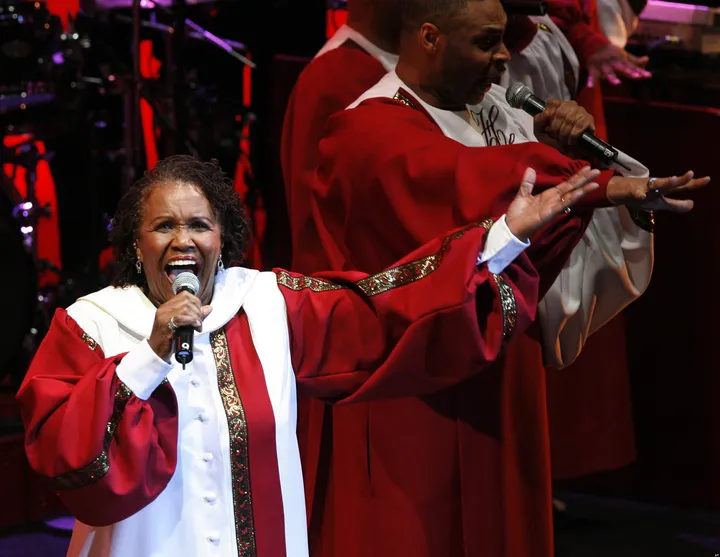
It might seem surprising to many people, but the world of black gospel music has always been paradoxical. The genre emerged in Chicago during the Great Migration when Thomas Andrew Dorsey brought all of his experience as a former "bluesman" to bear on its development. Now considered the "father of black gospel," Dorsey had been the piano player for "Ma" Rainey's Georgia Jazz band until a dramatic conversion experience in the late 1920s. His innovation, "Gospel Blues," merely joined sacred lyrics to Blues chord structures. Dorsey had come to reject the lifestyle of the bluesman, but he did not reject the blues. Indeed, he maintained that the emotionally evocative nature of the blues could be of tremendous service to church music, working toward the "same feeling." As a result, however, Dorsey and a number of other early gospel performers were thrown out of some of the most established black churches in the country. What is now widely recognized as the "classic" sound of black gospel was once just as widely considered to be the "Devil's music."
The lives of gospel performers have reflected the fact that black gospel was born in tension between the sacred and the secular, the church and the world, human passions and spiritual inclinations. Even some of the most revered figures within the tradition lead complicated lives that were often marked as much by materialism, self- interest, contradiction and competition as by the desire to spread the "good news." During the height of black gospel's popularity in the 1950s and 1960s, many gospel singers such as Mahalia Jackson, Sister Rosetta Tharpe, Marion Williams and Clara Ward amassed modest fortunes and took great pride in displaying their material wealth in the form of expensive cars, fur coats, lavish homes and furnishings. When Clara Ward dramatically cast her Mink wrap at Mahalia Jackson's coffin during Jackson's funeral in 1972, it was possibly a gesture of respect for the departed "Queen of Gospel," but it
was without question a display of Ward's material prosperity. As Semple, the wise and sardonic Langston Hughes character, observed, "Some gospel singers these days are making so much money, when you hear them crying, 'I cannot bear my burden alone,' what they really mean is, 'help me get my cross to my Cadillac.'"
The seeming contradiction between the message of black gospel and the lives of many gospel singers became an enormous issue on the "gospel highway" between the 1950s and 1970s, effectively splitting gospel singers into two camps, "ministers" and "performers." It also may account for the popularity of Dorsey's tune, "I've Got to Live the Life I Sing about in My Songs," made famous, perhaps ironically, by Mahalia Jackson.
Gospel singers of the past were not saints and their lives did not always conform, privately or publicly, to conventional standards of Christian piety. The same can be said for today's crop of black gospel singers whose personal presentation and public performances seem a direct response to market demands and the result of their commercial success. (Gospel music is a multi-million dollar industry.) Their lives are just as fraught with complications, apparent compromise and contradictions as their predecessors. The gospel road has always been a hard road. Failing to navigate its bumps, twists and turns can cost you something professionally and personally. Tonéx (aka Anthony Williams), the gospel artist who came out as gay in 2007 could certainly attest to that.
Even more so than the complexities of the gospel life, however, what links these performers across the generations is the glorious music itself. Black gospel music is America's finest creation, the soundtrack of this nation. It is a genre of music that has been able to articulate all the hopes, fears, trials and triumphs of the human spirit, as well as express our salvific anticipation of that heavenly tomorrow. And most of these gospel singers can really sing it too! Think Yolanda Adams, Smokie Norful, the Clark Sisters, Mary Mary, Shirley Caesar and all the Winans. As Langston's Semple says, they may be "working in the vineyard of the Lord and digging in his gold mines," but that's OK, "as long as they keep singing as they do".