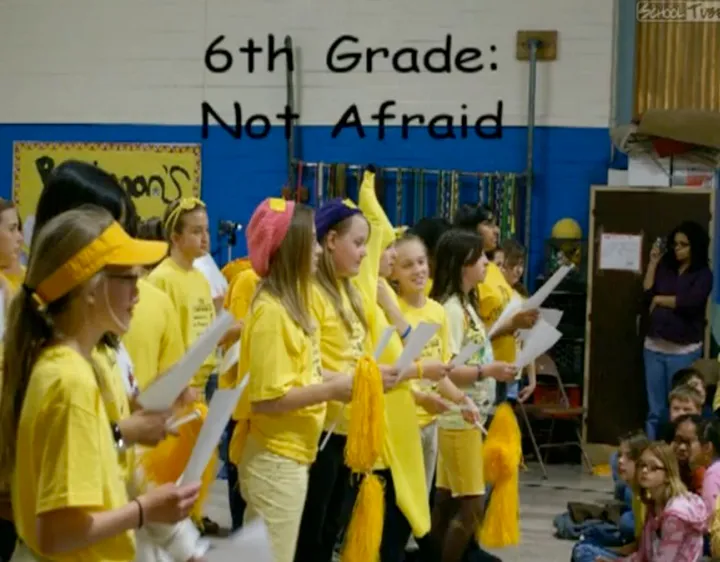
First, let me say that I'm not specifically picking on the teachers and kids at Emerson Elementary in Pennsylvania, who put together this 12-plus minute video of their Pennsylvania System of School Assessment (PSSA) pep rally for the state standardized tests, and posted it to TeacherTube a couple of weeks ago. Do a search on YouTube and you can find dozens of similar efforts. I am, however, picking on a culture of schooling that feels the need to pump up students for test-taking with chanting and dancing that, on some level, makes me actually shudder as a parent. Take a look. (Skip to 3:07 if you want to get the gist of event.)
You have to wonder, is this really what we've come to in schools? That we have to remind kids that they are "bigger than the test" and show pictures of kids with captions like "6th Grade: Not Afraid" in an effort to steel their nerves? That showing what they've "learned" in schools is something they have to mentally prepare themselves for instead of just naturally exhibit? Really?
As I said, Emerson is not alone in this pep rally effort. But I wonder what the parents of those kids at Emerson think of this. Sad to say, most of them probably are just going along with the flow, missing the whole point of what their kids are really learning by going through this exercise -- that the test is what we do school for, and that it's something to be conquered.
It's not the test that parents and kids should fear. It's the loss of real learning that these kinds of assessments cost them. To summarize my ranting TEDxNYEd talk from last month: If all we want for our kids is to pass the test, we really don't need schools any longer. Just load 'em up with a computer, an Internet connection and some test prep guides, and send them to Khan Academy or any number of other similar sites, and let them go crazy.
But here is why we don't want to do that. In that type of interaction, we lose all the beauty of learning, the passion behind it, the motivation for it, the engagement that comes with the process of thinking deeply about things we care about, asking big questions and finding big answers together. And, most importantly, putting those answers to good use by applying them in ways that add to our collective knowledge, not just end up as filled-in bubbles on the test.
I know what those teachers at Emerson and other places are trying to do. They're trying to help their kids be successful because this is how the politicians and businessmen and 100 years of tradition have defined success. But don't miss the point: the tests have little to do with learning. The tests we give our kids aren't assessing their learning; they are assessing their knowledge. At the end of the day, the PSSA won't show one thing about what kids can actually do with any of the stuff they've spent countless hours of test prep getting ready for.
Ironically (or maybe not so ironically), some parents in Pennsylvania are saying "ENOUGH!" They're going to their legislators and educating them on the reality of the current testing culture that is harming kids and leaving them worse off as learners. They're pulling their kids out of the test to make a statement, one that is a personal statement for now but, if more people join in, could send a powerful message to the education "leaders" in this country that we have to think differently.
What's most disconcerting, however, is the message all of this sends to our kids about learning -- that it's all about mastering content and skills that other people think are important, that all of the rewards are extrinsic, and that success is more about what we know than what we can do with what we know. None of this tells us anything about the qualities we most want from our children: a love of learning, a willingness and the patience to grapple with important, real problems, and the ability to make sense of the world as they experience it. And there's no doubt that those things are getting lost in the process of prepping for the test.
And besides, we don't need pep rallies for kids who love learning, do we?
Follow Will Richardson on Twitter: www.twitter.com/willrich45
Julie Woestehoff: Obama, Duncan Want 'Better Tests'? We Need Better Answers First
How Standardized Testing Damages Education | FairTest
A Brief History of Standardized Testing - TIME
Standardized Testing: Measuring What Matters Least
Go ahead and keep your kids out of tests but that will be held against the schools and even more will be labeled as failing. When that happens you can complain even more.
Elect some people who aren't going to cave in to the corporate testing companies and then come back to talk about this.
Then those parents who want a true education for their
children (as opposed to obedience training) should take
their kids out of school on test day.
The politicians and business people who are leading this
testing mania and profiting from it will soon get the hint.
Imagine if we started a "refuse the test" movement.... or, for that matter, a viable progressive movement of like minded people for any of the myriad of abominations facing us today.
"I would prefer not to take your test."
However, in this era of high-stakes testing, schools will try reward days, pep rallies and any other gimmick they can to motivate kids to try harder. When school funding, teacher and administrator jobs....even the future existence of the school itself hangs in the balance with every new round of test scores, you do what you have to do.
I just felt the need to add my 2 cents about rallys and the things we do as educators that may seem wacky. Not a comment on this particuar rally, but just my point of view. Thanks for your article. Hope it makes others think as well.
Push back. Hard.
Good luck - Mark
So we teach and we encourage and we motivate and we incentivize and we recognize and we chastise all with the test in mind. Not because anyone here buys into the intrinsic importance of test scores, but because everyone fears the extrinsic results of failure to measure up to an arbitrary standard.
If one school did that, that school would be punished. But if every school did it, we'd all be better off.
I agree with you that the teachers aren't at fault. But really, they (and the parents, and the students, and the rest of us) should be resisting more.
I am disappointed by your use of hyperbole because it dulls what is otherwise a good point: that school should be about finding the passion for learning.
To say that standardized tests won't show one thing about what kids can do is inflammatory and way too far on one side of the line to help solve the problem at hand. Does 100% proficient equal a good school? Of course not, even the best state tests are low bars and most educators would admit that. But if a school only has 10% of it's students passing a reading test - the community needs to know because something isn't right. Tests do tell us something. Can your student take what they learned in math and apply it to a different problem? Can your student take the English skills they learned and decode an essay they've never seen? Does your student have the executive functioning skills, skills necessary in the world, to weigh possible answers, prioritize questions and organize their time? Tests are not a complete answer and you wouldn't have to push hard to get any urban educator to say they are inaccessible to students with disabilities and inherently biased. But they do measure what kids can do. And that's one step towards improving our schools.
Couldn't you encourage dialogue instead of phrasing this as a battle cry?
Yesterday I was at a school that doesn't give grades. None. Not one. Yet many of the kids that graduate from that school go on to prestigious colleges because admissions officers get a full portfolio and written assessments from teachers and mentors. Yet most aren't willing to think that creatively and out of the box even though it's a much better solution for our kids.
Standardized assessments hurt kids. It drives all of the engagement, enthusiasm and creativity out of our kids. Watch the video. The message we are sending by "pepping" them up for this absurdity is almost as bad.
http://www.thefrustratedteacher.com/2011/04/concerned-father-and-8th-grade-test.html