So what are you doing on September 26? That is the date of National Public Lands
Day and as in years past, more than 100,000 Americans will be volunteering at
thousands of public parks, forests, and wildlife refuges. They will be pulling
weeds, building trails, hauling trash, and generally doing what they can to
polish up our precious public realm.
A project of the National Environmental Education
Foundation, this day got started in 1994 with three federal agencies and 700
volunteers. Last year 120,000 volunteers showed up at more than 1,800 sites.
The effort taps into a rising spirit of volunteerism among
Americans—an effort being amply nurtured by the federal government.
Volunteerism has been a theme in recent presidential administrations. This
spring President Obama and Congress began a process to triple the size of
AmeriCorps, the federal network of national service programs. At about the same
time, the administration launched Serve.gov,
an online resource for finding and creating volunteer opportunities. In this
difficult economy, when public agency budgets are down, volunteer efforts that
help enhance and maintain our public assets are more important than ever
Nowhere is this truer than with our federal, state, and
local parks and open space. Fortunately, our strong connections to the land—to
parks, playgrounds, gardens, lakes, trails, and natural areas—often compel us
to give back and support them in any way we can.
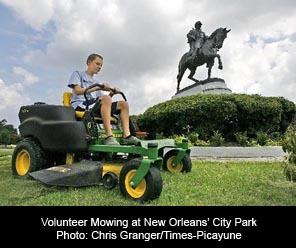
One of the most heartening volunteers and parks stories I
know of comes from New Orleans after Hurricane Katrina. Before the storm,
1,300-acre City Park was the
seventh most visited park in America—a much-loved destination for more than 11
million visitors each year, including its neighbors.
Katrina left 90 percent of the park covered in floodwaters
and its infrastructure a shambles. But that deluge was succeeded by an
outpouring of volunteer support. Beginning with the tennis players, who chopped
falling limbs off of the shattered courts, more than 6,500 volunteers donated
more than 34,000 hours to the park in the 18 months after the storm—and many of
them have stayed. Take, for example, the Mow-Rons, volunteers who
began cutting the park’s grass with their own lawnmowers in the weeks after
Katrina. Today the group’s seven core members keep mowers at the park and cut
the grass every Saturday morning.
This kind of volunteer service goes on at parks across
the country every day. So why not give it a try? To find a Public Lands day
event near you, go to www.publiclandsday.org.
Like the Mow-Rons of City Park, you may find that experience to be both
gratifying and habit-forming.