
The Independent Institute has released a timely report on the costs of war in Afghanistan, Iraq and beyond. Among the findings:
-- Thus far, increases in spending on the war in Afghanistan have consumed the bulk of the savings from the drawdown in Iraq. The combined costs of the two wars will amount to nearly $170 billion this year. That's $19 billion less than FY2008, the peak year of the Bush administration's war spending. But it's a modest drop once you consider that spending on Iraq has decreased by almost $100 billion since FY2008. In other words, four out of five dollars "saved" from the drawdown in Iraq were reinvested in the Afghan buildup;
-- Total fatalities in Iraq and Afghanistan were higher in 2010 (559) than they were in 2008 (469), the last year of the Bush administration. This is largely because of the Obama administration's tripling of U.S. troops in Afghanistan and its more aggressive strategy there, which has in turn led to more than three times as many fatalities there in 2010 compared with 2008;
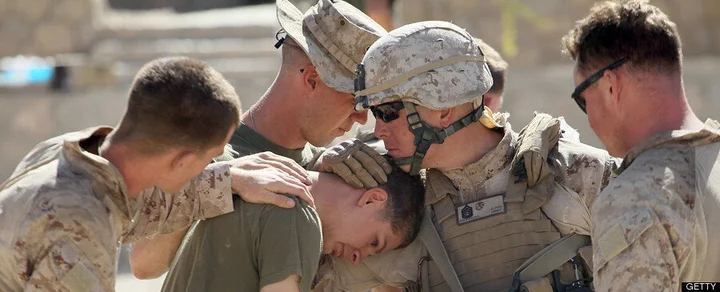
-- Rising casualties in the ranks of private military contractors have obscured the full human costs of the wars. In the first six months of 2010, more civilian contractors died (250) than military personnel (235).
The Independent Institute report's findings come at a time when both the public and key political leaders are coming to question the costs of the wars, Afghanistan in particular. As Sen. Richard Lugar (R-IN), the ranking Republican on the Senate Foreign Relations Committee, put it, Afghanistan "does not carry a strategic value that justifies 100,000 American troops and a $100 billion per year cost, especially given current fiscal conditions." Obama administration insiders have made similar comments, calling the war "simply not sustainable" at its current cost and suggesting that the debate is shifting from "is the strategy working?" to "Can we afford this?"
The war's cost is phenomenal if one looks at it compared to the amounts spent on other national security objectives. For example, as Rajiv Chandrasekaran of the Washington Post has observed, "Last year, the United States spent nearly $1.3 billion on civilian reconstruction projects in one district of Helmand province -- home to 80,000 people who live mostly in mud-brick compounds -- about as much as it provided Egypt in military assistance."
The cost concern has been a major factor in turning the public and the Congress against the war, impatient for a drawdown and anxious to hear a clear "end game" strategy from the administration. In a Gallup/USA Today poll taken in early May, 59% of respondents opposed the war and favored bringing the troops home. And the House of Representatives recently came within a few votes (204 to 215) of passing the "Afghanistan Exit and Accountability Act," co-sponsored by Rep. Jim McGovern (D-MA) and Rep. Walter Jones (R-NC).
Costs aren't the only issue in Afghanistan, but they are the issue most likely to put the Obama administration on the spot as to how they expect to succeed there, and in what time frame. As their own official said, the current state of affairs is "simply not sustainable."
William D. Hartung is the director of the Arms and Security Project at the Center for International Policy and the author of Prophets of War: Lockheed Martin and the Making of the Military-Industrial Complex (Nation Books, 2011).
The US killed bin Laden and hence accomplished our mission. It is time for us to leave
1. Giving private contractors "no-bid," "cost-plus" awards, guaranteeing they'll waste and spend as much as possible, while profitting from the abuse.
2. Paying contractors in advance for services-goods, which are then often delayed, defective or sometimes don't get delivered at all.
3. Using $100-K mercenaries and over-paid private contractors, rather than regular military personnel for security, interrogations, construction, etc.
4. Expanding the "war on terror" to Yemen, Somalia, and now our engagement in Libya.
5. Keeping non-strategic bases open (many from the Cold-War era) here and abroad.
6. Maintaining funding for weapons-equipment and items the military does not request, need, many of which are obsolete.
Before the US even thinks about a military option, two things must be in place as a condition:
1. A war tax, so everyone contributes to the cost of war. We don't need any more unfunded, off-budget wars adding to our deficits-debt.
2. Reinstate the draft, so those who are able-bodied participate (no deferments or exemptions). If a war's worth fighting, then everyone should be called upon to serve their country.
Only one answer, blow some of them up, and then more business resupplying. That is the only option to continue getting money from the taxpayers, enabled by our corrupt system. As an example, take the missiles that were fired at Libya. Made by Raytheon, they cost $1 million each. The first salvo was some 150 of them. So, suddenly Ratheon has a new $150 million in business. I don't know how many of these missils they shoot off this year, but 500 of them is $1/2 billion. And thats just for missles. Think about the bombs?
Would this not be that they are the great bulk in Iraq, and large amounts of them in Afg. I wondered.
"for more than 50 percent of the Pentagon's $400 billion procurement budget, ... DOD Expects To Retain Up To 22000 Contractors In Iraq After Pull-Out ... a recent DOD report on military contractors in the U.S. Central Command area. ..."
"Jun 3, 2011... paying for the 225000 military "contractors" that supplement our soldiers, ... with a deep recession and an unemployment rate of near 10 percent? ... We're coming up on the end of seven years of war in Iraq. ...
www.american-reporter.com/4,215/329.html -"
Sorry, can't find actual percentages, they all seem unavailable.
We are B-R-O-K-E!!!! Can't fix our own infrastructure, millions without jobs, foreclosures continuing, education suffering, medical costs (especially healthcare premiums) rising, businesses closing, many more vets returning with multiple loss of limbs, food costs and fuel sky-high.
Whatever happened to protecting and serving our own people?
This investment in Afghanistan is either stupid or wickedly self-serving.
All the military spending developing roads, schools, bridges, water treatment plants in the middle east should be spent here. Our infrastructure is crumbling, millions are unemployed.
Lets solve two problems with one decisive action.
And reduce "uncertainty" in the bargain.
Done.
BOTH Rumsfeld the day before 911 and Cynthia McKinney, years after, have mentioned the 2.3 trillion missing from the military budget every year. That was in 2000 mind you.
My point being, these wars are sadly a distraction to the trillions of dollars in secret money pouring through the cracks every year. What are we spending this money on?
I'd bet its all connected and related to the ills of both Iraq and Afghanistan. While contractors were making billions, troops were having to contend with contaminated water and getting electrocuted in showers while their familes back home have been barely able to make it financially.
And on top of that there is a 2 trillion dollar leak per year? What else are they not telling us?
We're waiting, Obama...
Donald Rumsfield
2.3 trillion total... not per year. Not missing just hard to track from the top because of layers of incompatible accounting systems. Total military budget is less than 700 billion. Conspiracy theories are not helpful.
Is there someone "looking" for the tin foil hat here?
The "official" pentagon budget is less than 700 billion. Folks are coming forward trying to tell you that much more gets spent than that. A lot more!!!!
But if people don't want to know, or even question this, go ahead and let them call it conspiracy theory. Dismissing it as "conspiracy theory" is a cop out...it squelches discussion and debate, and it absolves the person's responsibility to think past the surface for themselves.
Just pinning this fact as conspiracy theory doesn't disprove what I've questioned here.
I'd rather challenge myself and others to step outside of that trap, and find out the truth.
This should've all been treated as an International Police Action aimed specifically at the people guilty of specific acts of terror against the US, UK and others. Not 2 wars. Not for 9/11. The response was just so clearly captured and re-directed for reasons of hugely corrupted military business processes.
In any event, virtually any kind of out - all the way out of Afghanistan, and Iraq, and Pakistan, and out of ALL the rest region has a popular ring in these areas we really ought to paying more attention to: how much they would prefer to be free to do what they desire rather than what they are told by an occupying invader.