iPhone app iPad app Android phone app Android tablet app More

Featuring fresh takes and real-time analysis from HuffPost's signature lineup of contributors
Yao Ming

GET UPDATES FROM Yao Ming
 

A Lesson in Extinction

Posted: 08/10/2012 9:12 am

For several years now, I've been working with WildAid to promote wildlife conservation and to reduce the demand for products derived from endangered or threatened species. It's encouraging to see how many people have been supportive of the campaign to reduce pressure on the world's sharks by saying "no" to shark fin soup. Since becoming involved in this campaign and learning more about the threats to wildlife, I wanted to go and see what's happening to some of these animals myself and so I'm heading to Africa for the first time to learn about elephants and rhinos, two species in peril as a result of demand for ivory and rhino horn.

After finishing up the great experience of commentating on Olympic basketball for CCTV, my journey begins at London's world-renowned Natural History Museum, a beautiful building dating back to 1873, with one of the world's best collections of fossils and animal specimens -- approximately 70 million items in total. I wanted to learn more about our planet's wildlife, both past and present, and better understand the root and the implications of extinction.

My guide is Dr. Samuel Turvey of the Zoological Society of London, who spent time studying in China. We started in the Dinosaur Hall -- beautiful and impressive. It would have been amazing to see one of these animals alive. Next to these guys, I'm feeling pretty small. Their extinction is thought to have been caused by an asteroid hitting the earth, causing a massive dust cloud -- unavoidable and natural.

We saw the skeletons and exhibits of many animals that are now extinct. I learned that, in the grand scheme of things, extinction can be a natural process, a part of animals and plants adapting and changing -- all part of evolution. But every so often there is a mass extinction event like the asteroid strike, which scientists believe wiped out the dinosaurs.

Many scientists believe we are now in the middle of the sixth great mass extinction, but for the first time, it's being caused by an animal -- human beings.
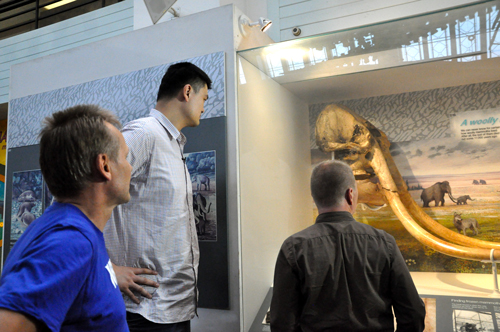
2012-08-10-DSC_0015.jpg

Dr. Samuel Turvey discusses extinction with Yao Ming and WildAid Executive Director Peter Knights at the Natural History Museum in London
Courtesy of WildAid

Now for many species facing extinction or near extinction, the threat is being caused by human activity -- deforestation or the conversion of habitat to agricultural land, introducing foreign species that wipe out local species, and from over hunting.

Scientists estimate the current rate of extinction is perhaps 1,000 times greater than what would be considered natural. And the scale and pace of the changes is so extreme that animals don't have time to adapt and evolve.

Seeing all these animals made me realize the amazing diversity of this incredible planet we inhabit and how shortsighted we are if we let more creatures disappear on our watch and by our hand.

The tour continued with woolly mammoths, giant ground sloths and the Giant Moa bird. From what we know, it seems many large animals like this lived all over the world. Today, Dr. Turvey tells me that the only places you can really see animals of this stature and witness great wildlife diversity are in Africa and a few isolated parts of Asia. I learned that elephants and rhinos once thrived in China, but today we only have a few elephants and rhinos are long gone.

Both elephants and rhinos are being hunted at record levels for their ivory and horns. I was really shocked to learn that even dead rhinos aren't safe. Across Europe, organized criminals have been stealing rhino horns from museums to supply the Asian market for rhino horns. Now, museums are replacing the horns on exhibit with fake ones. Sam told me, ironically, many of these museum horns may have been treated with preservatives so anyone trying to use these stolen horns may actually be poisoning themselves.

It's sad that even our museums aren't safe from the demand. If people are resorting to stealing rhino horns from museums to meet the demand, this doesn't bode well for rhinos in the wild.

We'll find out more in Africa. You can follow my journey at http://yaomingblog.com
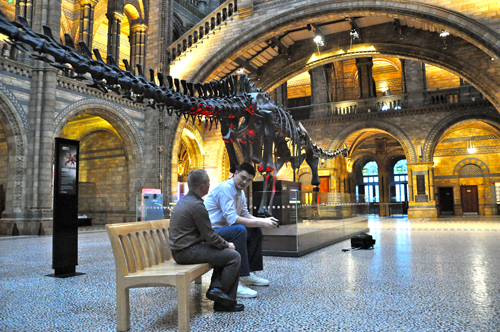
2012-08-10-DSC_0027.jpg
Dr. Samuel Turvey and Yao Ming in the Central Hall of the Natural History Museum in London
Courtesy of WildAid
 

Follow Yao Ming on Twitter: www.twitter.com/YaoMing

FOLLOW GREEN
For several years now, I've been working with WildAid to promote wildlife conservation and to reduce the demand for products derived from endangered or threatened species. It's encouraging to see how ...
 
 
  • Comments
  • 63
  • Pending Comments
  • 0
  • View FAQ
Comments are closed for this entry
View All
Favorites
Recency  | 
Popularity
Page: 1 2 3 4  Next ›  Last »  (4 total)
02:14 PM on 08/26/2012
Thank you so much, for using your notoriety and your universal credibility, to help
put more focus on the plight of endangered species, in all parts of our globe.
You have the respect, dignity and grace - to give a special voice to the beautiful creatures,
who are facing so many risks and threats.
Thank you very much Yao Ming.
09:52 PM on 08/12/2012
It amazes me that an American can go to Africa, if he/she has paid enough, and hunt wild game that most of us think is endangered. A person willing to pay enough, and stay in country long enough, can kill a lion. Only a female lion, but still a lion. The list of animals even includes giraffes!! Who would want to kill a giraffe!
photo
HUFFPOST SUPER USER
UnknownSolider
08:13 PM on 08/12/2012
Good work Yao
HUFFPOST SUPER USER
William50
07:56 PM on 08/12/2012
Laying around because a few honey bees decided they did not like where my foot was in the grass I was watching 10,000 BC and the climate change and destruction of many species including Clovis man because of ice age, not man made, a short 1000 year return to ice age, not man caused and possible hit by a meteor. not man caused. Wow, 12,000 years ago it started to get warm, melted the three mile ice cube of North America and then when the cold water changed course and changed the warm water pattern in the ocean we had a thousand years of damn cold again.
But this is or may be a cycle and what is even more scary is ice is the norm and heat, yes as we now have is a summer vacation, earth time before winter sets in again.
So, perhaps what is more needed are a few real space liners before this race goes the way of the North American Horse!
This user has chosen to opt out of the Badges program
03:16 PM on 08/12/2012
Don't go to Africa, instead, go to Spain and tell Juan Carlos to stop poaching for ivory over there.
This user has chosen to opt out of the Badges program
photo
02:50 PM on 08/12/2012
Take it a step further: Think about the redwood or cypress product that may have been in the living 1000 year old organism a few months earlier. The 60 year old lobster that died for a few moments of culinary pleasure.
photo
Artemesian
Spiritual Messenger of the Earth
01:01 PM on 08/12/2012
I was so happy to read this. Thank you, Yao! :)
photo
HUFFPOST SUPER USER
Duke1225
09:26 AM on 08/12/2012
How wonderful that you are doing this work! Because of your sports achievements, you are uniquely qualified to be able to affect positive change for wildlife. I look forward to following your journey!
HUFFPOST SUPER USER
OCerInTN
Hoplophobics worst nightmare.
01:04 AM on 08/12/2012
Make sure you inform people of the explosion of the elephant population in the countries where legal hunting is practiced.
08:36 PM on 08/11/2012
Go after the end-user , get rid of that problem and there will be noreason to kill them. The end-user is why they are harvested. Going to the critter will only add to it*s stress--put the stress on the end-user
This user has chosen to opt out of the Badges program
02:16 PM on 08/11/2012
Yao!

Study your own species. We are about to wipe ourselves off the planet by our own doing.
12:22 PM on 08/11/2012
Yao Ming, you are a great ambassador for wildlife protection. I have read and seen your videos, highlighting the courageous plight of the Moon Bears in bile extraction farms. Thank you for your commitment to spreading awareness and compassion and action.
photo
batguano
As Long As Grass Grow, Wind Blow & The Sky Is Blue
11:15 AM on 08/11/2012
How rare for a celebrity to talk the talk & walk the walk; usually it’s get rich & forget the rest, I applaud your integrity & moral compass. It's especially important ancient cultures holding destructive views/customs change. Unless we become good stewards of our only Earth, we are doomed; the arrogance of dominance can only last so long before greed & contempt for lives of other humans & animals becomes our own end. We destroy our common environment with total disregard, our air & water poisoned for profit/money & "development". Stay your course and you will be a great, & much-needed, force for change.

"If all the beasts were gone, we would die from a great loneliness of spirit, for whatever happens to the beast, soon happens to us. All things are connected. Whatever befalls the Earth befalls the children of earth. Man did not create the web of life - he is merely a strand in it. Whatever he does to the web, he does to himself." -- Ted Perry


"Only when the last tree has died & the last river been poisoned & the last fish been caught will we realize we cannot eat money" -- Cree Proverb


"We are the most dangerous species of life on the planet, & every other species, even the earth itself, has cause to fear our power to exterminate. But we are also the only species which, when it chooses to do so, will go to great effort to save what it
photo
batguano
As Long As Grass Grow, Wind Blow & The Sky Is Blue
10:29 PM on 08/11/2012
Dropped ending....... "But we are also the only species which, when it chooses to do so, will go to great effort to save what it might destroy" -- Wallace Stegner"
08:46 AM on 08/11/2012
While our megafauna gets the attention it is important to remember that these losses are being replicated throughout the ecological web. The unglamorous invertebrates and small vertebrates have suffered immensely. Their roles in the ecosystem are very important and frequently unrecognized until their contributions are reduced, or eliminated. For those who study these populations there have been incredible changes in the fabric of the communities and homogenization of what remains. It is worrisome. Nonetheless thanks for anything you do to promote conservation of the remaining biological community. As a species we have a biophilic component, we just need to cultivate it.
photo
HUFFPOST SUPER USER
Linus521
In wildness is the salvation of mankind
12:42 PM on 08/11/2012
Beautiful commentary! The ecological web is the web of all life, including mankind's. Yes, these species create and sustain entire ecosystems, and ecosystems supply humankind with all his life giving and sustaining cycles, services and functions -- from oxygen releasing, fresh water, the nitrogen cycle, the atmosphere, and ecosystems' water cycle cools the climate and a long list of all the reasons Earth sustains all life.

The species facing the threats of extinction imminently are amphibians and reptiles, and birds are in decline on every continent. A scientific paper points to frogs as in the eco-nomy and a job-holder of protecting mankind from global, diseases and epidemics -- faring horribly globally. I would think this would also include lizards, some snakes, some birds and bats. Many of these species are in the business of pest control as well, as ecosystems provide 99% of all pest control. Without this eco-nomy, valued as almost priceless, agriculture would suffer.

We must remember, we are alive because of ecosystems, and ecosystems are life giving because of the rainbow of living, from microorganisms in the soil, weaving through countless chains of life to top predators, like wolves and mountain lions.

"In wildness is the salvation of the Earth and the preservation of all life...but seldom perceived by man."
photo
robadeau
Your labels have expired
11:58 AM on 08/12/2012
A species facing a serious threat of extinction at the hands of humanity is humans.
Funny, that.
12:17 AM on 08/11/2012
Great post. I hope you continue to write on this issue.