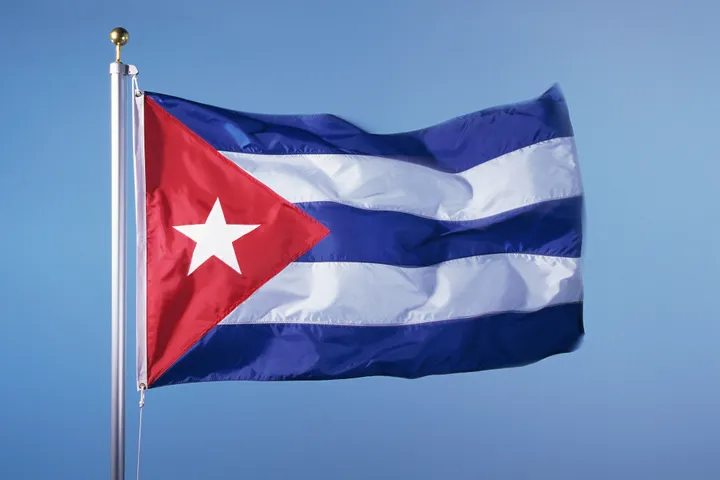
How many telephones do you think are listened into by the political police? I asked a man who once worked for state intelligence and who now is just one more private citizen. I ventured a three-digit number, a modest count that provoked gales of laughter across his wrinkled face. "Up to the mid-90s about 21,000 lines were tapped, and now it must be double that with the addition of cellphones." Another gentleman confirmed the number; his work had once been nosing around in other people's conversations and installing microphones in the homes of dissidents, state officials and even inconvenient artists. I spent the day I heard such a bloated number feeling Big Brother's eye on every tree, in every corner of my house, thinking about the indiscreet ear stationed in that little gadget with a screen and a keyboard that I carry in my pocket.
ETECSA, the only phone company in the country, uses its status as a state monopoly over communications to provide listening services to the Ministry of the Interior. This is not a delusion of my fevered brain. I have tried taking apart my phone, even removing the battery and leaving town; the nervousness of the "shadows" who guard my house is immediately evident. Sometimes, just to amuse myself -- I freely admit it -- I use my cellphone to invite several friends to participate in some presentation of an official book or an event organized by a state institution. The resulting operation would seem almost comical, if it weren't for the evidence of the excessive resources -- which should be contributing to the well-being of the people -- that the government devotes to such things.
The watchers, however, can also become the watched. ETECSA employees leaked a data base through the alternative networks with many details about the country's telephone numbers. Without a doubt a violation of the discretion any company should exercise over its information about its clients. But this has served to unmask the phone numbers of those who watch and denigrate us. From journalists working for the newspaper Granma, to members of the Central Committee, to senior police officials, their data appeared with their identity card numbers and even their home addresses. Brief acronyms show which phones are paid for by government agencies and which are private. This exposes the official links of many who call themselves independent. For once, the detailed inventory they've made on every citizen has served for us to know about "them," to know that those who are listening on the other end of the line have names, not just pseudonyms. Now, anyone can call them, send them a message, something as short and direct as a text saying "Enough already!"
Yoani's blog, Generation Y, can be read here in English translation.
Translating Cuba is a new compilation blog with Yoani and other Cuban bloggers in English.
Yoani's new book in English, Havana Real, can be ordered here.
Follow Yoani Sanchez on Twitter: www.twitter.com/yoanifromcuba
“East Germany had a major role in building up Cuban counterintelligence as well as its foreign intelligence services, providing training for decades . . . right up to the final days of East Germany,” said Chris Simmon, a career U.S. counterintelligence officer and expert on Cuban intelligence.
“'The repressive system that existed in East Germany . . . is the same one that exists today in Cuba,” he says. “What MININT learned from the Stasi has not been forgotten.”
Jorge Luís Vázquez, a Cuban exile who was jailed in one of the Stasi cells in 1987 in East Germany under communist rule, now leads tours through the prison-turned-museum.
Vázquez says he found the MININT is ''almost a copy'' of the repressive Stasi security system, exported by East Germany to Cuba in the 1970s and '80s, and that the ties between the two organizations run far deeper than previously known.
''I want to provoke a change,'' Vázquez says. ``I want to hold the Cuban government responsible; I want to denounce it for its collaboration with the Stasi.''
So I am not sure what kind of freedoms you are advocating for Cuba, but as things stand the Cuban people have at least as much freedom from Big Brother Government as their counterparts in the US. The ponly people that Castro does not allow to run roughshod over the Cuban population are the crooked banks and hedgefund managers and we now know what allowing those guys free rein does to a country. Another not too fine a point if you want to see how kind and gentle the government of the US is just take a look at the clips from the Oakland OWS protests. We do not see that in Havanna.
Pinochet killed people, why then to criticize PolPot for killing people???
USA spies terrorists, why then to criticize castrofascism for spying normal citizens????
Somewhere in the world there is something wrong, why then to criticize castrofascism wrong doing????
Castrofascism's logic!!!!
(Washington, DC) - The conviction of six dissidents in summary trials for doing no more than exercising their fundamental rights highlights the continuing abuse of the criminal justice system to repress dissent in Cuba, Human Rights Watch said today. Raúl Castro's government should immediately release the prisoners, who were given sentences ranging from two to five years in prison, and cease all politically motivated repression against Cubans who exercise their fundamental freedoms, said Human Rights Watch.
Cuba's laws empower the state to criminalize virtually all forms of dissent, and grant officials extraordinary authority to penalize people who try to exercise their basic rights. The Cuban Criminal Code penalizes anyone who "threatens, libels or slanders, defames, affronts or in any other way insults or offends, with the spoken word or in writing, the dignity or decorum of an authority, public functionary, or his agents or auxiliaries." The violations are punishable by one to three years in prison, if directed at high ranking officials. Such laws violate the right to freedom of expression recognized in article 19 of the International Covenant on Civil and Political Rights - signed by Cuba in 2008.
http://www.hrw.org/en/news/2011/06/01/cuba-stop-imprisoning-peaceful-dissidents
There are more terrorists per squre mile in USAmerican than in the rest of the world combined.. Just look at miami
HUMAN RIGHTS WATCH
Imprisoned for ‘Dangerousness’ in Cuba by Nik Steinberg
Published in: The Washington Post-February 27, 2010
"Under Cuba’s “dangerousness” law, authorities can imprison people who have not committed a crime on the suspicion that they might commit one in the future. “Dangerous” activities include handing out copies of the Universal Declaration of Human Rights, writing articles critical of the government and trying to start an independent union."
http://www.hrw.org/en/news/2010/02/27/imprisoned-dangerousness-cuba
MIAMI HERALD : Corruption investigation reported in Cuba- By Juan O. Tamayo - 08.08.11
Cuban prosecutors are investigating several top officials of ETECSA, the state telecommunications monopoly, on allegations of corruption, according to knowledgeable sources in Havana and Miami.
Havana residents separately said that the version making the rounds there has several top ETECSA officials detained or under interrogation as part of an investigation into corruption, although the exact allegations were not known.
While the exact nature of the corruption alleged in the ETECSA case remained unknown, the Empresa de Telecomunicaciones de Cuba S.A., considered one of the largest enterprises on the island, marked two milestones this year.
And in January, Telecom Italia sold its 27 percent ownership of ETECSA to Rafin, a Cuban firm variously described in news reports as owned by the island’s armed forces or as personally controlled by Cuban rulers Fidel and Raúl Castro.
Rafín was created in 1997 with the stated purpose of negotiating, buying and selling financial instruments, and paid $706 million to the Italian telecommunication company, according to the news reports. It is unclear how Rafín paid for the deal.
http://www.miamiherald.com/2011/08/07/2350047/corruption-investigation-reported.html