iPhone app iPad app Android phone app Android tablet app More

Featuring fresh takes and real-time analysis from HuffPost's signature lineup of contributors
Yoani Sanchez

GET UPDATES FROM Yoani Sanchez
 

Cuba's Workers Union (There Is Only One), Reports to the Regime

Posted: 05/11/2012 4:50 pm

2012-05-11-unidadvictoria.jpg
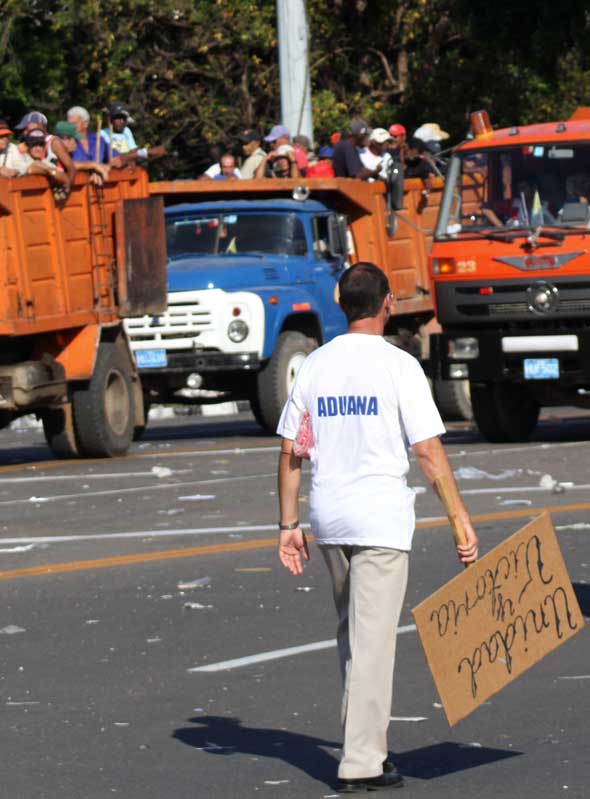
Photo: After the Parade

If anything distinguishes May Day from other days in the year, it's not the parade, nor the crowd waving its paper flags. The most striking is the silence that falls over Havana after the mass rally in the Plaza of the Revolution. A stillness interrupted only by the few cars that roam the streets and by some cop who blows his whistle at the corner. All the schools, workplaces, government agencies and bus stops are empty.

This scenario has been repeated for decades, but this year, in 2012, something broke the habitual tedium of the Day of the Workers. Many private businesses, known here as "the self-employeds," opened their doors despite the holiday, skipping the commemoration to throw themselves into selling pizzas, ice cream, fruit smoothies. While others launched slogans of Revolutionary reaffirmation, they launched products, fishing in the peaceful river left by closed State shops.

It's expected that at the end of this year around 600,000 Cubans will have take out a license to work in the private sector. Among them will be many who lost their jobs because of the downsizing happening throughout the country. In the coming months, more than 170,000 jobs will be eliminated in the different spheres belonging to the State and the personnel will be relocated to other work or dismissed.

The euphemisms that characterize the official language have reached their highest expression in referring to this unpopular process. The cuts are called "labor reorganization" and people who are left unemployed are classified as "availables." As if such peculiarities in vocabulary weren't enough, the only union authorized in the country has supported the decision to "deflate the payrolls to achieve efficiency."

The Cuban Workers Union has made it clear that its role is to be at the side of the employer, not the employees. A posture that surprises not one of its almost three million members, accustomed to the disciplined paying of their dues, but aware that this organization represents the powers-that-be against the base, and not the inverse.

To this same obedient union more than 80 percent of the more than 370,000 self-employed have subscribed, and one representation of them paraded on May Day. They haven't signed up to represented or defended, but to avoid problems. They intuit -- with good reason -- that not joining could suggest they are "apathetic," "bourgeois," and in the worst case, "counterrevolutionaries."

They all, undoubtedly, would prefer an association to defend them from the high taxes, to convene protests over the lack of wholesale markets, and to demand bank loans to support their businesses. Able to choose, they wouldn't have voted for Salvador Valdes Mesa, the current secretary general of the Cuban Workers Union, whose previous job was in the antagonistic Ministry of Labor.

Instead of the Church in the hands of Luther, our version seems to be the Union caught in the arms of the Boss. A federation that has supported the elimination of half a million jobs by 2015, and that has called for a greater commitment to the government of Raul Castro. A negative legacy of this passive and complicit attitude, will be the refusal of many workers to join its ranks and those of other proletarian organizations. The word "union" in Cuba will have to shake off its current connotations of inaction, to return to that irreverent and autonomous role it once held.

For now, on the platform on May Day, instead of a message of protest slogans, there are calls for discipline, demands for control. Labor disagreement has no place at the Plaza of triumphal slogans and praise for the current system. Not a single block represents the unemployed, not one fist is raised in protest, not one sign calls the authorities to account.

Many of those present have attended for the same reason they've registered with the Cuban Workers Union, so as not to be marked as opposed to a political process in which they can no longer believe. They smile for the cameras, some with their children on their shoulders, but nothing in them of the rebellious essence of a Labor Day.

When the parade ends then return home, or venture into the surrounding streets looking for something to eat or drink. They end up buying it at the counter of some self-employed, non-union member who stayed open to conduct business on the holiday.

The next morning the official newspaper, Granma, proudly published the red-letter headline, "This was the more organized and fastest parade" in our history. And for once, Granma is right.


Follow Yoani Sanchez on Twitter: www.twitter.com/yoanifromcuba

FOLLOW WORLD
Photo: After the Parade If anything distinguishes May Day from other days in the year, it's not the parade, nor the crowd waving its paper flags. The most striking is the silence that falls over Hav...
 
 
  • Comments
  • 15
  • Pending Comments
  • 0
  • View FAQ
Comments are closed for this entry
View All
Favorites
Recency  | 
Popularity
oil patch
if you voted obama, you are to blame
12:09 PM on 05/13/2012
what!? communism failed?!!!?!??!?!?!?!?!?
socialism is the same thing???????
08:12 AM on 05/13/2012
The Central de Trabajadores de Cuba (CTC) is the central organisation for all trade unions in Cuba. There are 18 different national trade unions with workers organised by industrial sector.

• National Union of Iron, Steel and Machine Industry Workers (SNTM)
• National Union of Culture Workers (SNTC)
• National Union of Food Industry Workers (SNTIA)
• National Union of Chemical, Mining & Energy Industry Workers (SNTQME)
• National Union of Communication Workers (SNTC)
• National Union of Tobacco Workers (SNTT)
• National Union of Agricultural & Forestry Workers (SNTAF)
• National Union of Health Workers (SNTS)
• National Union of Commerce & Catering Workers (SNTTCG)
• National Union of Transportation Workers (SNTT)
• National Union of Light Industry Workers (SNTIL)
• National Union of Education, Science & Sports Workers (SNTECD)
• National Union of Public Administration Workers (SNTAP)
• National Union of Science Workers (SNTC)
• National Union of Construction Workers (SNTC)
• National Union of Armed Forces Civil Workers (SNTCFAR)
• National Union of Sugar Industry Workers (SNTA)
• National Union of Hotel & Tourism Workers (SNTHT)

Membership of a trade union in Cuba is voluntary and the unions are independent of the Communist Party and the state and the overwhelming majority of trade unionists are not Communist Party members. There is no state funding of trade unions in Cuba and national unions have their own by-laws and rule books. Industrial action is not prohibited in Cuba and, contrary to US propaganda, it never has been.
HUFFPOST SUPER USER
Humberto Capiro
11:29 AM on 05/13/2012
zenos! WHERE IS YOUR LINK? I SHOWED YOU MINE, YOU SHOW ME YOURS!

Background to Labor Rights in Cuba - World Movement for Democracy.

Independent unions, workers' rights to collective bargaining, and the right to strike are not recognized by the Cuban government. Individuals associated with independent unions are often fired, harassed, arrested, threatened with sanctions, physically attacked, and imprisoned for long periods of time. According to the International Confederation of Trade Unions (ICFTU), "Anyone who engages in independent trade union activity runs the risk of being persecuted and losing their job. Workers are required to keep an eye on their colleagues and report any 'dissident' activity."

Independent labor groups have had their property and belongings confiscated, and the state security has infiltrated the movement with state agents. In March 2003, 75 human rights activists, including seven leaders of independent trade unions, suffered harassment and imprisonment and were charged with "treason and conspiracy." The recent crackdown represented a violation of these workers' universal rights to freedom of expression and association.

The Cuban government only recognizes one official governmental trade union, the Central de Trabajadores Cubanos (Cuban Worker's Confederation- CTC).

http://www.cubasindical.org/docs/d122104.htm
05:25 PM on 05/13/2012
There have been very few disputes since the revolution in 1959 for the simple reason that any conflicts are resolved through negotiation and collective bargaining.

Every month an assembly of workers will review production and discuss problems with the management personnel. Local union leaders are present and contribute to all of these meetings.

Also, the Central de Trabajadores de Cuba (CTC) is fully involved in the legislative process and government policy making. Every law and regulation relating to employment and the economy is discussed, amended where necessary, and must be approved by the trade unions.
photo
HUFFPOST SUPER USER
Comrade Komar
Not approved.
11:22 AM on 05/15/2012
Here is Your link:
http://londonprogressivejournal.com/article/view/1116/trade-unions-in-cuba-and-the-emergence-of-a-private-sector
Here is the last part of that article:
"Whatever changes take place in Cuba over the course of the next several years, one thing seemed clear: any changes made will be implemented primarily in the interests of the people. Cuba will not adopt a US style capitalism model, as some may hope or fear. Cubans have worked too hard over the past fifty years to give up what they have achieved. At this year’s May Day march in Havana, a 100 metre banner carried by the Cubans at the front of the parade proclaimed Preservar y Perfeccionar el Socialism - Preserving and Perfecting Socialism."
Hope U like it.
HUFFPOST SUPER USER
Humberto Capiro
12:32 PM on 05/12/2012
UNIVERSITY OF PENNSYLVANIA WHARTON SCHOOL REPORT :Can Raul Castro's Reforms Create a New Cuba? -November 22, 2011

At first glance, Raul Castro seems to modeling his country's future after China and Vietnam, whose one-party, nominally communist governments have managed to maintain power for decades while also emerging as globally competitive exporters of industrial and agricultural goods. Look deeper, however, and it is apparent that Raul's approach won't turn Cuba into a miniature of those two much larger Asian communist countries, experts say. The key problem for Cuba is that Raul's reforms are not nearly as deep or thorough as those enacted by communist governments in China and Vietnam. Mesa Lago notes that in China and Vietnam, local farmers have been allowed to lease from the government the land that they work on for an indefinite time period. In Cuba, contracts to lease plots of land are valid for only 25 years. "After 25 years, that contract may or may not be renewed by the government, and the land may be seized by the Cuban state for social needs," Mesa Lago notes. That's particularly troubling because "a lot of land in Cuba has been taken over by the notorious marabou plant," says Adrian E. Tschoegl, a management lecturer and senior fellow at Wharton. It often takes two years just to clear marabou-infested land, Tschoegl adds, so a 25-year lease is effectively cut.

CLICK LINK FOR ENTIRE REPORT!

http://knowledge.wharton.upenn.edu/arabic/article.cfm?articleid=2744&language_id=1
This user has chosen to opt out of the Badges program
photo
11:05 AM on 05/12/2012
For more interesting and open minded blogs by Cubans from Cuba, read the Havana Times.

http://www.havanatimes.org/
HUFFPOST SUPER USER
Humberto Capiro
03:15 PM on 05/12/2012
I FOUND THIS ONE IN THE HAVANA TIMES!

HAVANA TIMES : The (Non) Right of Cubans to Travel -Haroldo Dilla Alfonso-February 1, 2010-

What I’m describing here is not for Cuban readers but for those who are unaware of the matter and are forced to accept the information of those who close their eyes to this flagrant civil rights violation.

Above all, travel for Cubans is not a right, but a legal privilege. It is a condition that can be granted or rescinded. It is a revocable concession by an unappealable power and is without a defined judicial framework.

In all cases, the departures of these people imply considerable fees that can end up in well excess of US $500, an immense sum for a population with exceedingly depressed wages that average $20 a month. In short, to leave, each person must be able to pay for a letter of invitation, a passport and an exit permit.

On top of this, once in the destination country, the traveler must make payments to the Cuban embassy in that country a sum that varies each month they remain in that country, which is a highly uncustomary practice. This sum fluctuates between $40 and $150 a month.

But we must pay them, and pay them well, so they can continue reproducing their power with the same parasitic style they’ve displayed over the last fifty years.

http://www.havanatimes.org/?p=18972
This user has chosen to opt out of the Badges program
photo
05:07 PM on 05/12/2012
I'm glad to see you took the time to read the Havana Times. Yoni Sanchez is not the only critic of the Cuban government in Cuba. She seems to be the only one who is permitted to publish in the Huffington Post, however. Much of the criticism expressed in the Times calls for Cuban solutions. Not all Cubans feel their only salvation lies with the United States. You can't argue that Cuba does not allow criticism. http://www.havanatimes.org/?page_id=571
08:55 AM on 05/13/2012
Unlike Sánchez, contributors to Havana Times don't advocate selling out their country to US economic colonialism. On the contrary, they see Socialism as very much part of Cuba's future, evolving into something similar in many way to Venezuela where, for example, co-operatives play a far greater part in the economy. Worker ownership is a model which has proved itself to be many times more dynamic than privately owned equivalents - which inevitably rely on coercion and exploitation of its workers - therefore returning far better performance figures than these privately owned equivalents.
This user has chosen to opt out of the Badges program
photo
10:54 AM on 05/13/2012
Exactly. Solidarity for Peace and Prosperity.
HUFFPOST SUPER USER
Humberto Capiro
10:40 PM on 05/11/2012
INTERNATIONAL CONFEDERATION OF FREE TRADE UNIONS (ICFTU) CUBA REPORT 2006:

There still is no freedom of association, no genuine collective bargaining and the right to strike is still not recognised in law. Six of the seven independent trade union leaders sentenced to lengthy terms in 2003 remained in prison. An independent trade union leader was arrested at the beginning of the year.

TRADE UNION RIGHTS IN LAW
A single union
The Cuban authorities only recognise a single national trade union centre, the Central de Trabajadores Cubanos (CTC). The Labour Code, which was published in 1985, does not provide for any genuine freedom of association. The government explicitly prohibits independent trade unions, though it claims there is no legal requirement for workers to join the CTC.

The government has told the ILO that it is undergoing a comprehensive revision of its Labour Code. A new code is unlikely to guarantee genuine freedom of association, as the government maintains that existing laws already do so. According to the Cuban authorities "Freedom of association, protected in Convention 87, does not translate into the false concept of 'trade union pluralism' imposed by the main centres of capitalist and imperial power."

CLICK LINK FOR ENTIRE REPORT!

The International Confederation of Free Trade Unions (ICFTU), was set up in 1949 and has 241 affiliated organisations in 156 countries and territories on all five continents, with a membership of 155 million, 40% of who are women.

http://www.icftu.org/displaydocument.asp?Index=991223866&Language=EN