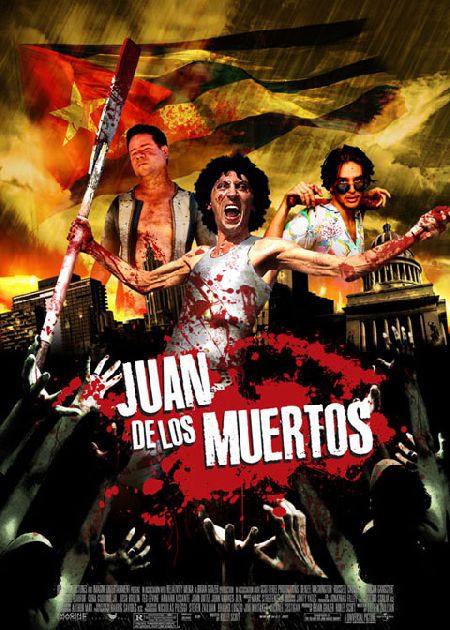
The nothingness, the apathy, the wall at the corner to sit on, forever wasting time. The hero of the film Juan of the Dead was already acting like a corpse before the zombies invaded Havana, a city in fact shrouded and dead. This fictional antihero calls on his creativity and ingenuity -- in the midst of chaos -- to establish a blood-chilling business. "We kill your loved ones," reads the slogan of the company he creates with other pals as dysfunctional as he is; its market niche is to hunt the living dead. An enjoyable script mixes humor and fantasy, special effects and unretouched reality. On this side of the screen viewers are caught between terror and snickers, watching the image of the Capitol destroyed by a helicopter and the emblematic Fosca building reduced to rubble. They laugh and cringe at the same time.
Directed by Alejandro Brugués, Juan of the Dead is causing a furor in the Cuban capital. It has provoked extremely long lines outside the movie theaters, some of which end up with police beatings and pepper spray falling on dozen of eyes. But the curiosity in this case has been greater than the caution. More than gazing on a story of beings taken from our worst nightmares, the public wants to decipher the second reading contained in the film. Especially in the scenes where hundreds of desperate people leap over the wall of the Malecon -- into the sea -- to escape a county where putrefaction is gaining ground.
Something of the automatism of the shock troops and of the mob prepared to attack those who are different, is also exhibited by these frightful creatures that the hero confronts and whom he can only overcome by "destroying their brains." And Juan is a character of great irreverence, someone who, according to his own words, has survived "Mariel, the war in Angola, the Special Period and what came later." Such that, between laughter and shrieks, the metaphor crumbles, it is more direct. And it ends up tossing into the laps of the audience, perched on their seats, the cynical but clear question: Won't you also be like corpses, a faraway look in your restless eyes, like zombies with no future plans, walking along La Rampa.*
*Translator's note: La Rampa is a long street running down to the Malecon, and the sea, the location of much of what passes for what is left of Havana's night life.
Yoani's blog, Generation Y, can be read here in English translation.
Translating Cuba is a compilation blog with Yoani and other Cuban bloggers in English.
Yoani's new book in English, Havana Real, can be ordered here.
Follow Yoani Sanchez on Twitter: www.twitter.com/yoanifromcuba
It takes only one look at failed states like Haiti and Dominican Republican to appreciate how advanced Cuban society truly is, despite half a century of unrelenting and irrational economic, political and subversion warfare by the United States.
Cubans do not believe they will benefit from Raul Castro’s economic reforms, and many fear that their personal situation will become worse, according to a special report – Real Change for Cuba? How Citizens View Their Country’s Future – released today by Freedom House.
Freedom House’s study, based on 120 in-depth interviews with a diverse set of Cubans in six provinces, found that Cubans remain preoccupied with economic concerns and often have trouble meeting daily needs. Although recent announcements about economic reforms have raised expectations, many respondents said they have little control over their situation and are afraid of losing the minimal government support mechanisms that have helped them to survive.
http://www.freedomhouse.org/template.cfm?page=70&release=1427
Socio-Economic Conditions in Pre-Castro Cuba*
Introduction
In the 1950's Cuba was, socially and economically, a relatively advanced country, certainly by Latin American standards and, in some areas, by world standards.
Cuba's infant mortality rate was the best in Latin America -- and the 13th lowest in the world.
Cuba also had an excellent educational system and impressive literacy rates in the 1950's.
Pre-Castro Cuba ranked third in Latin America in per capita food consumption.
Cuba ranked first in Latin America and fifth in the world in television sets per capita.
Pre-Castro Cuba had 58 daily newspapers of differing political hues and ranked eighth in the world in number of radio stations.
http://ctp.iccas.miami.edu/FACTS_Web/Cuba%20Facts%20Issue%2043%20December.htm
http://www.peoplesworld.org/applying-money-and-words-to-defeat-the-cuban-revolution/
Their government was replaced by former Soviet clown-zombies who are still around and more archaic than the 1950s Edsel relics on their roads, but not as valuable.
Zombies in the White House would be more plausible.
It's simple: The embargo keeps them in power. And most Cubans prefer Castro's system to US control, even if they don't care for the Castros themselves.
Cubans in Cuba esp don't want to be anything like the US after hearing from relatives in the US how life there is.
http://www.youtube.com/watch?v=mJlHSB--BpY
Brutal police repression by the dictatorship of the Castro brothers against members of the Patriotic Union of Cuba (UNPACU) in the march Live Boitel-Zapata on 2/12/11 in the eastern city of Palma Soriano, Santiago of de Cuba.
This march was organized and led by former prisoners of conscience of the Black Spring of Cuba José Daniel Ferrer and Angel Moya Acosta, national coordinators of the UNPACU, the former and promoters of the march the latter!
In this video you can see the fear of the dictatorship of the Castro brothers of losing control of the streets, hundreds of uniformed police and security agents of the state (political police), in civilian clothes is the way they operate, to prevent the peaceful march of fifty peaceful men. They fear that people will join these courageous opponents who struggle for freedom and democracy. So they gather all their repressive apparatus to hit and stop those participating in this event. It should be noted, as seen in the image, that the dictatorship used school buses by the so called "Pastors for Peace" who have have been to Cuba.
SOLIDARITY WITH THE CUBAN PEOPLE WHO WANT TO LIVE IN FREEDOM!
Enough of this injustice and evil!
I for one would rather hear from someone besides a CIA asset when it comes to Cuba.
http://milfuegos.blogspot.com/2010/01/contradictions-of-cuban-blogger-and-cia.html
http://machetera.wordpress.com/2009/11/11/yoani-sanchez-a-few-cards-short-of-a-full-deck/
http://www.democraticunderground.com/discuss/duboard.php?az=view_all&address=405x14941
http://machetera.wordpress.com/2009/05/08/yoani-sanchez-pentagon-babe/
YOUTUBE : Václav Havel speaks about Cuba
http://www.youtube.com/watch?v=C1si3jBduCI
No need to use CAPITAL letters unless you intend to express your words in a hysterial shriek. Cojelo suave chico...
All dollar signs of course point to the US govt.
It is in the countries there most aligned to the USA that we find the rogue military, the death squad, the mordida, and the inevitable drug trade.
Instead of its independence is this what Ms Sanchez would prefer for her homeland?
YOUTUBE : DOCUMENTARY - "Soy la Otra Cuba" - Pierantonio Maria Micciarelli / Realizador Italiano (Documentary "I am the Other Cuba")
http://www.youtube.com/watch?v=ga-gcUoFwsA
Documentary that exposes the current Cuban reality.
"When I was young I was fascinated by the myth of the Cuban revolution, but being now in Cuba and saw another face reality. They are people of great valor and courage despite the fact that Cubans are imprisoned in their own home. I knew it was a project dangerous but it was my story, real and proper, that I should continue it "
Maria Micciarelli Pierantonio.