
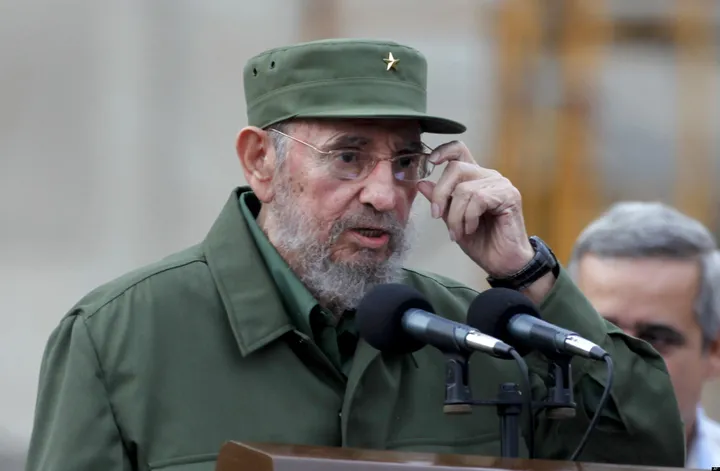
I was just a babe in the arms of my militia mother, an unformed chip of a New Man, when Fidel Castro traveled to Libya in the spring of 1977. Received with full honors by Colonel Muammar Gaddafi, he awarded him the Medal of Valor, a distinction conferred for the first time on a foreign personality. In front of the cameras the commander-in-chief rewarded the recently named leader of the revolution with a handshake. They looked at each other and recognized their similarities. Later, in a closed door meeting away from the television cameras, they strengthened the foundations of an alliance that would last more than thirty years.
Cuba and Libya embarked on parallel paths that would join on more than one occasion. The point of major overlap centered on their leaders, in the sympathy the two caudillos expressed for each other. Thus, in 1980, when our island was shaken by the mass escape of more than 100,000 Cubans, Gaddafi officially extended his hand in solidarity. In a message filled with praise, he congratulated Fidel Castro for having been re-elected as first secretary of the central committee at the 2nd Communist Party Congress. The military academy man had been at the helm of that vast North African territory for more than a decade, while we exceeded that with twenty years of listening to the interminable discourses of the Maximum Leader. Both based their rhetoric in part on the free social services they offered their people. It was the way they reminded us -- day after day -- about the birdseed, without ever mentioning the cage.
Jamahiriya -- a state of the masses -- is the term Gaddafi coined to describe the political system he adopted in 1977, a kind of republic in the hands of everyone, very similar to the slogan, "The power of the people is indeed the power," that they repeated to us on this side of the Atlantic. If things didn't work in Libya, the citizens themselves were to blame for not knowing how to lead their nation; if the economic collapse took hold in Cuba it was because of individual laziness and people's wastefulness, cracking the face of Utopia. Both leaders waved before their subjects' eyes the specter of foreign invasion and a return to political dependence, the worst of threats. Anti-colonialism became the big bad wolf of the eccentric Berber leader, while the Caribbean leader scratched around in the mud of anti-imperialism, turning the metaphor of David and Goliath into a perennial reference to Cuba and the United States.
The nineties found them both scorched by the fires they had built with their stubbornness and belligerence. Gaddafi needed to clean up his image with the West, while urging Fidel Castro to raise foreign exchange to allow him to remain in power after the collapse of the socialist block. The eccentric Libyan president paid compensation, timidly opened his country to foreign investment, renounced -- at least publicly -- terrorism, and was even invited by Barack Obama to the G-8 Summit. The commander in olive-green was more cautious, beginning a process of economic reforms which he then tried to control with a return to centralization, qualifying his bellicose speech with phrases alluding to the ecological damage suffered by the planet, and ending the first decade of this millennium by presenting himself, now, as an ancient wise man publishing his illuminating reflections.
The official Cuban press slipped in his first criticisms of the performance of the brother-leader of the great Libyan revolution. He questioned the radical reform of the socialist regime which, according to him, could lead to "popular capitalism." It seemed the roads that had intertwined over and over again were beginning to move along completely different paths.
But with my then 23 years, I had witnessed the affectionate grip the two caudillos shared. Unlike in March 1977, my mother didn't want to hear anything about her militia uniform, and the Libyan leader was hard to recognize under the make-up, head cloths, and sunglasses. In 1998, when Fidel Castro participated in the Conference of the Non-Aligned Movement, he was honored with The Muammar Gaddafi Human Rights Prize which came with a whopping $250,000. It was clear that the exchange of awards constituted -- along with economic and military cooperation, declarations of solidarity, and the absence of condemnation -- another form of mutual support in one of those ways that, over and over again, power recognizes and supports power, just so long as it sees the shine of its own reflection.
Yoani's blog, Generation Y, can be read here in English translation.
Translating Cuba is a new compilation blog with Yoani and other Cuban bloggers in English.