After the Ottoman Empire turned to the modern Turkish republic in 1922, Western powers used a variety of means to draw new maps and lines around lands that were administered previous through a uniquely Islamic understanding of government. The most similar Western approach to the Ottoman government might be understood as 'monarchical-federalism'. The main goal of the West's previous efforts had been the dismantlement of this conglomeration of Muslim lands, so it was natural that their main priority would be to plan a future which would prevent any sort of reunification.
Muslims had suffered a loss which was akin to excommunicating the Pope from the Catholic Church. As the ruler of all that was Islamdom, Sultan Abdul Hamid II was sent into exile, earning his bread from his carpentry work for the rest of his life. Muslims were left leaderless like they hadn't been for 1400 years.
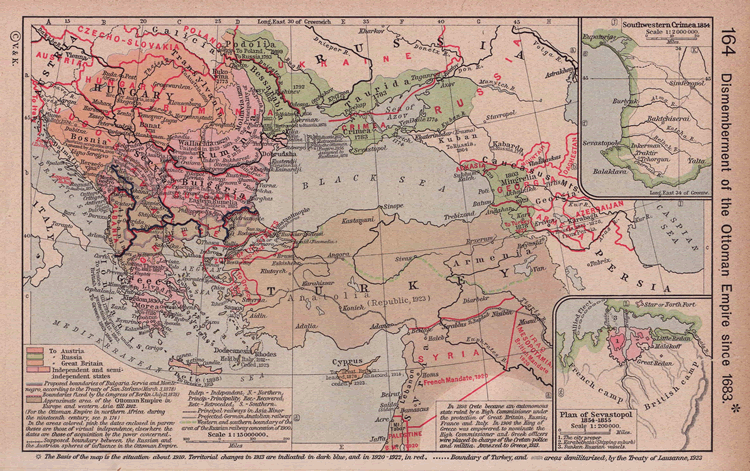
One can imagine these architects of tomorrow, in their smokey offices, deciding which new tribe they would support here, and how they would prop up this rival over there. Welfare of the people living under these new structures was a non-factor in these decisions. It only made sense, much of these plans were thought up in the early days of total world war.
Much of the Muslim masses were convinced that the end of times had come. And in a way, it had. An era of a singular coherent Islamic orthodoxy had ended. Muslims had lived in a society for over a millennia governed by a state which conducted itself according to it's own unique and complex system of checks and balances, an almost bureaucratic system of religious debate, and an overarching Sultan intervening between rival government factions.
This robust system was replaced with a scattering of dictators and 'princes' with little experience in running their personal families, much less nations. New states popped up without the authority or the coherency of any legal tradition. Scrambling, they incorporated various pieces of the French Republic and other western governing systems and brought them into their various dictatorships and new monarchies. This was sufficient 'progress' for the West.
Yet, Muslim masses would hardly accept the authority of a piece of paper, without some reference to God. Much like the idea that "one nation, under God" conveys, Muslims hold a strong belief that a completely godless state is no state worth living in. God ran strong through these lands, and anyone wielding authority which openly ran in contrary to a village elders faith would soon be dealing with countless rebellions.
However, villagers were hardly people learned in the religious development of the Muslim empire and the nuances of delicate legal cases and precedent. And when it came to the religion, what was to replace the Sultanate was a confusing mesh of secular and religious opinions, ranging from the most extreme to the most liberal. The removal of any social entity which could qualify people to make religious opinions left the direction of Islam in chaos. The rise of the printing press and mass media ensured the confusion would easily penetrate into the ordinary Muslim's homes. Due to this amorphous state of Islamic authority, any reference to religion within the modern states law had to be vague and transient at best.
We can see this impetus to include an undefined religious authority occurring within our nation-building even today. Iraq's new constitution states in Article 2:
"First: Islam is the official religion of the State and it is a fundamental source of legislation:A. No law that contradicts the established provisions of Islam may be established."
Yet at the same time, it dictates:
"B. No law that contradicts the principles of democracy may be established."
Can one democratically contradict the 'established provisions of Islam'? What are these 'established provisions', and whose 'established provisions' are they? No one knows the answer to these questions, yet.
Going back to historical trends, we've seen numerous states establish 'Sharia' Laws within their normal legislative process. These laws, which have had a lasting imprint on the mind of Western observers, often pronounce strict and severe punishments: cutting of hands, lashings, stonings. It is interesting to note that the laws which the states chose to announce and implement are those with the most severe punishments against the populace.
These dictator-states and pseudo-democracies seemed to desire blurring the lines between their own tyrannous rule and God's most severe justice. It seemed they wanted to distract people: "Don't forget, we're Muslims. Yeah, we do horrible things. But don't blame us, some of these horrible things are from God."
Islamic laws which reward charity, promote honesty, promote tolerance have been forgotten in these states, while a handful of 'Shariah' punishments were mixed in with brand-new torturous and oppressive policies and procedures.
Interestingly enough, these selected 'Sharia' punishments were frowned upon under the centuries of Ottoman rule and by its end had become completely unpracticed. In Ottoman lands where Sharia was the be-all, end-all official state law, these laws were unenforced as a matter of practice. This was not through denouncing or revising Islamic Law, but by putting into practice the complete and holistic set of checks and balances built into Islamic Sharia.
This meant, for example, that while the punishment of adultery was technically announced as 'stoning', one also needed an absurd four witnesses of the most upright character to see actual sexual penetration to even entertain the possibility of this maximum punishment. On top of that unlikely scenario, if one of those witnesses ever spoke a white lie to anyone, their character would be insufficient to hold up in the courts and the case was to be discarded. When these impossible-to-meet criteria are considered, it becomes clear that these punishments were intended to be demonstrations of the severity of the act in the eyes of the Lord (and hence society), and deterrents in all practical senses.
This is not unlike the death penalty in New Hampshire, where no one has been executed since 1939, and there is no death chamber to be found in the state. Such laws remain 'in the books' as deterrents, yet through various legal or social methods they can become unenforced as a matter of practice.
However, modern 'Islamic' states have revitalized these punishments without the wisdom of their historical application. The purpose of this has been to announce their regressive and incomplete application of Sharia. The powers-that-be ultimately hope that this process would bring legitimacy and a distraction from the corruption and cognitive dissonance which permeates through their governments.
'Blasphemy laws' today in Pakistan are the latest example of supposed 'Sharia laws' hitting the newswire.
How do we reconcile such laws with the story of Mary Fisher, a Christian Quaker, who came to preach 'blasphemy' to the king of all of Muslim lands in 1658? After being given the opportunity to directly preach her Christian message to the Muslim Sultan, Mehmet IV, Fisher was received with friendship, care and consideration and offered safe passage through Muslim lands.
The following account relates the exchange between them:
... he (Sultan Mehmet IV) told her to speak the word of the Lord without fear, since they had "good hearts" to hear it; strictly enjoined her moreover, to say neither more nor less than the word she had from the Lord, since they were willing to hear it, be it what it might. With great gravity the whole assembly gave heed to her earnest ministry, and when she became silent the Sultan asked if there were nothing more she would like to say? When she inquired whether he had understood her, he answered, "yea, every word, and it is truth!" He then expressed his desire that she should remain in his dominions, and when she declined this proposal, offered her a guard to escort her to Constantinople, as he would be greatly grieved if any harm should befall her in his empire. But she courteously refused this offer, trusting in the Lord alone.May we not hope that one who had, for the moment, ignored the great national contest between the Crescent and the Cross, and -- far beyond this -- laid aside the prejudices of the exacting faith of his fathers in his readiness to hear "the word of the Lord" albeit from the lips of a woman ..
(ref: Friends' Intelligencer Vol XXXIII (1877). Philadelphia: John Comly)

Member of the Nusseibeh family, Muslim, opens
the Church of the Holy Sepulchre's doors
Before the dissolution of the Ottoman khalifate, apostasy and other blasphemy laws were rarely spoken of and last practiced back when Americans were still accusing each other (and killing) as witches in Salem in 1692. Blasphemy laws resulting in capital punishments were openly stopped through new edicts and perspectives in 1839, specifically by a decree known as the Noble Edict of the Rose Chamber.
Far from imposing and executing various religious communities, Muslims lived with, and even ruled over, numerous rival Christian communities. Muslims were forced to decide disputes between these Christian sects. The Church of the Holy Sepulchre is a prime example of Muslim arbitration and administration in negotiating a peaceful and progressive approach between Christians of various denominations. Up until this day, a Muslim family holds the honor of opening the door to allow the various Christian denominations to enter and worship. The arrangement of responsibilities between the Christian sects was decided with Muslim governance.
It seems more than coincidental that these 'Sharia' incidents occur in states that are run by atheistic/communist dictators (i.e. Saddam Hussein) or ridiculously corrupt 'Islamo-democratic' governments.
In Pakistan's case, the International Crisis Group provided a report last year stating:
Decades of mismanagement, political manipulation and corruption have rendered Pakistan's civil service incapable of providing effective governance and basic public services. In public perceptions, the country's 2.4 million civil servants are widely seen as unresponsive and corrupt, and bureaucratic procedures cumbersome and exploitative. Bureaucratic dysfunction and low capacity undermine governance, providing opportunities to the military to subvert the democratic transition and to extremists to destabilise the state.
Ridiculous distractions such as modern 'Islamic' states opinions on blasphemy, adultery, and theft allow Islamophobes to target their favorite religion, while allowing corruption and real problems to go under the radar. These laws today serve a purpose that they never had in what was the most authentic Islamic state (now only a memory): a means to prove a governments religiosity in a midst of lies, deceit, money and total corruption which make up most of its actual administration.
It seems clear that, after looking at the historical examples cited, obtuse punishments and announcements of one's religiosity (especially by a government), are a sign of a troubled spiritual state.
It is high time for Muslims to accept that what is making Muslim states un-Islamic isn't a possible repeal of blasphemy laws. It is the distance from the spirit of charity, honesty and sincerity which is a fundamental aspect of any true believer in the Day of Judgment, regardless of creed. Today's Muslim leaders could learn a lot from the open exchange between Sultan Mehmet IV and Mary Fisher, and the Sharia as he understood and practiced it. One needs only consider what would happen to Mary Fisher if she approached most of today's Muslim politicians and religious leaders.
Non-Muslims, on the other hand, need to quit associating these puppet governments and their lip-service to 'Sharia law' as the defacto Islam which they wish to judge Muslims with. After all, they helped create these pseudo Islamic monstrosities.
Follow Yursil Kidwai on Twitter: www.twitter.com/yursil
Sharia - Wikipedia, the free encyclopedia
Islam: Governing Under Sharia - Council on Foreign Relations
American Thinker: Top ten reasons why sharia is bad for all societies
More states enter debate on sharia law - USATODAY.com
Fears of Sharia Law in America Grow Among Conservatives ...
When Islamic civilization was strong and confident and could defend itself, it was invariably more accommodating, today Islamic civilization is fractured, insecure, under constant attack and as a result more reactionary. The same would hold true for the West, look how rhetoric changed after 9/11. Imagine if America or the west were under similar distress the Muslim world is in currently, would it still uphold the freedom of religion, speech, diversity it does now? Would it be able to uphold its justice as eloquently if its judicial system had collapsed? The answer is absolutely NO!
Western/humanistic ethical and judicial implementation would crumble if its material wealth vanished. Much of western ethical concepts could not even be implemented without the technology it posseses. One day it will crumble, just like it has for every civilization. Considering the immense destruction and dislocation of the loss of the Caliphate the muslim world suffered and continues to suffer due to war, westernizaiton, interference, etc. Islam has been a glue between families and communities and source of spiritual truth for billions and it will continue to be so. No matter how much some may hate it or us.
The complexity of Sharia-Law is difficult to understand because it is impossible to reconcile the source code it is based off from a modern, moral perspective. Remember, EVERYTHING in Islam is based off what one 7th century man said/did.
Bukhari (5:59:462)
http://www.usc.edu/schools/college/crcc/engagement/resources/texts/muslim/hadith/bukhari/059.sbt.html#005.059.462
The background for the Qur'anic requirement of four witnesses to adultery. Muhammad's favorite wife, Aisha, was accused of cheating [on her polygamous husband]. Three witnesses corroborated the event, but Muhammad did not want to believe it, and so established the arbitrary rule that four witnesses are required.
http://qa.sunnipath.com/issue_view.asp?id=12121
I hope the sarcasm there wasn’t too condescending there but I think there are times where simply rephrasing what you just said allows you to hear what you sound like to other people.
I know this might be hard for you to understand but I truly have NO problem with Muslims.
If your argument is true, then the most heinous acts according to the most perfect source that will ever exist are basically freedom of thought/Religion (apostasy), engaging in sexual activity with the same sex or with a partner outside of one of the 4 legal marriages (known as Zina - unless of course it was with of the unlimited sex slaves) or falsely accusing someone of having “illegal” sex.
(Paging Dr. Freud…)
What am I missing? – drinking Alcohol? (how ironic the rivers of wine up in heaven). Ok, since Alcohol consumption is not unanimously agreed by all Islamic jurists as Hudud I we will exclude it. Any thing else really frowned upon by God and thus defined as Huddon?
Of course murder also makes the Hadd list right? Nope. That apparently isn’t anything God considers that "severe"– just pay off some Diyya (blood money) compensation and be done with it –feel free to take an “eye for an eye” retribution in addition to the compensation if you'd like– though it is best to just take the money.
A women’s testimony is only equal to half that of a man’s? I know you know better than that but that doesn’t make the verse go away.
Sorry my friend, the Qur an is simply not an acceptable basis for any modern system of government or morality.
Mary Fisher, was probably not perceived as mocking or negating God, after all she too believed in God. Less obfuscating, would be a significant heritage of very vocal Atheists fairing well under authentic Islam in the past. And what about the future; how will the emerging Turkish Islamic revival probably treat dissenting voices? Will any attacks on dissent simply be dismissed as non-authentic Islam?
Islam is an ideology invented by a sexually deviant seventh century political despot. Mohamed appropriated and twisted Christian and Jewish mythology along with dietary and tribal law. Islam oppresses women and is a real danger to the free West. Mohamed is considered a perfect man and Muslims around the world attempt to emulate him. This is why Muslims marry six year old little girls and have plural marriages, stone rape victims, chop off hands of thieves, and beat their wives. All of those things Mohamed set as an example. I am surprised the author isn't aware of these things.
Sharia isn't compatible with the American Constitution.
Every year the OIC within the UN passes a resolution that would ban free speech in the name of "tolerance".
Islam has its own Declaration of Human Rights, and does not recognize the UN Declaration.
http://www.debbieschlussel.com/30813/wikileaks-13-of-muslims-support-violent-jihadterrorism-almost-50-want-shariaislamic-law-to-govern-uk-24-muslims-claimed-disability-muslims-most-unemployed/
A survey of 600 Muslim students at 30 universities throughout Britain found that 32 per cent of Musli ms respondents believed ki!!ing in the name of religion is justified.
A U.S. diplomatic cable from January 2009 quoted a poll by the Centre for Social Cohesion as saying 54 per cent wanted a Muslim party to represent their world view in Parliament and 40 per cent want Muslims in the UK to be under Sharia law.
Mere anarchy is loosed upon the world,
The blood-dimmed tide is loosed, and everywhere
The ceremony of innocence is drowned;
The best lack all conviction, while the worst
Are full of passionate intensity."
Yeats
There are still a lot of Muslims who don't understand the strict guidelines of Sharia. I think some fear that they'll come of as reformists and just conforming to Western pressure. It's unfortunate but hopefully that will change soon.
Reza Aslan talked about this education thing before. He says that if America gave the money they did to Arab countries with strings attached (X% of dollars should be spent on schools, X% on medicine, etc.) we could expedite this process. Currently America gives money, but with no stipulations.
Armenian genocide dispute
http://news.bbc.co.uk/2/hi/6045182.stm
There is general agreement that hundreds of thousands of Armenians died when the Ottoman Turks deported them en masse from eastern Anatolia to the Syrian desert and elsewhere in 1915-16. They were killed or died from starvation or disease.
The total number of Armenian dead is disputed. Armenians say 1.5 million died. The Republic of Turkey estimates the total to be 300,000.
According to the International Association of Genocide Scholars, the death toll was "more than a million".
Very true and this is the problem we need to be focusing on. Individual Muslims should look into the intellectual tradition of Islam and it's spiritual teachings in an effort to correct our troubled spiritual state. Our problems cannot be alleviated by mere legalities. Change is only made at the grass roots- this is clear in the scripture.
As for blasphemy- the Qur'an repeatly mentions the insults that the Quraysh leaders hurled on to the Prophet. So I take that to mean that "blasphemy" is actually an integral part of our spiritual growth. It teaches us how to develop restraint, intellect and thought. NO where in the Qur'an is Muhammad instructed to lash out at those putting him down. Rather, he is instructed to "forgive, overlook, and be patient about what they say". Those who are reactionary about insults to the prophet- it is understandable in that he should be like a family member to us. But, it also shows the weakness of our understanding and faith- Islam has been attacked by orientalists throughout the centuries. If religious truth were that weak that it could not be defended through discussion, training, education and research, it would have been dead long ago. Many folks in the old country don't have access to that kind of training, but with time it will come.
- I think you are way off reality.
http://www.islamicvoice.com/April2006/QuestionHour-DrZakirNaik/
Regarding the punishment for blasphemy in Islam, it is mentioned in the Glorious Qur’an:
“The punishment of those who wage war against Allah and His Messenger, and strive with might for mischief through the land is: execution, or crucifixion, or the cutting off of hands and feet from opposite sides, or exile from the land: that is their disgrace in this world, and a heavy punishment is theirs in the Hereafter;” [Surah Al-Maidah 5:33].
In Islam, a person who has committed blasphemy can either be killed or crucified, or his opposite hands and feet can be cut off, or he can be exiled from that land. On the other hand, in other religions there is no other option except capital punishment. Islam at least has four options of punishment for an act of blasphemy.
Muhammad Asad commentary on 5:33 -
In short, the attempt of the commentators to interpret the above verse as a "legal injunction" must be categorically rejected, however great the names of the persons responsible for it. On the other hand, a really convincing interpretation suggests itself to us at once as soon as we read the verse - as it ought to be read - in the present tense: for, read in this way, the verse reveals itself immediately as a statement of fact - a declaration of the inescapability of the retribution which "those who make war on God" bring upon themselves. Their hostility to ethical imperatives causes them to lose sight of all moral values; and their consequent mutual discord and "perverseness" gives rise to unending strife among themselves for the sake of worldly gain and power: they kill one another in great numbers, and torture and mutilate one another in great numbers, with the result that whole communities are wiped out or, as the Quran puts it, "banished from (the face of) the earth". It is this interpretation alone that takes full account of all the expressions occurring in this verse - the reference to "great numbers" in connection with deeds of extreme violence, the "banishment from the earth", and, lastly, the fact that these horrors are expressed in the terms used by Pharaoh, the "enemy
By Jacob Thomas
http://www.scribd.com/doc/16594743/The-Intolerable-Life-of-Dhimmis-in-19th-Century-Damascus-19-June-2009
“Another example of Christian humiliation occurred in Damascus. When leaving his
home, a Christian was required to have a sac slung over his shoulder, in order to be ready
to accompany a Muslim on his way to the market and carry (in his sac) the groceries of
that Muslim “boss”! Quite often, such a Christian might spend most of his day in this
forced and degrading service to unknown Muslims he had met by chance!
===============
Silly kuffar. Why don't they realize that Muslim rule is the best thing for them. Right, Abdur?
Well, that's just what comes of being born Muslim and not having the good sense or just being too stubborn to realize it. Right, Abdur?
Islam being a universal submission to One True Almighty God, has no concept of a particular Covenant or a specially chosen people as Jews believe.
It also differs from the Christian view of the kingdom of God in heaven and separate Kingdom of Caesar ( Bushco Obama Corp) on earth.
Islam is a faith, a law, a way of life , a nation and a state, with a system of jurisprudence that is continually evolving ( Islamic laws certainly not fixed) for the administration of this world and the satisfaction of human needs under the sovereignty of the creator of the world.
Islam’s Kingdom of God on earth, with its faith, its laws, piety, rituals, society and state, is the prelude and the means to the afterlife.
It is equally true that Muslims share many of the beliefs and precepts of other religions, particularly Judaism and Christianity. But Muslims have limited common ground with modern consumerism and materialistic ideologies.
Islam may share a belief in the importance of this world, the kingdom on earth, but Muslims ask, “WHY WITHOUT GOD THE CREATOR?” and Why a life whose rituals are based solely on economics and sensuality?
With such ideologies Islam finds no possibility of compromise
Islam stands firm on individual piety and individual freedom, a close knit family devoted to the welfare of every relative, and a class-less benevolent society
- some articles or books on neuroscience, biology, etc.
- a book on ethics and human nature
- own one or two pairs of shoes, etc.
- throw away the TV and resurrect some old traditions like family storytelling, singing, poetry and crafts
- sit still for a few minutes everyday and just be present
- say I love you, inside, to everybody you meet
There is no afterlife and there is no God; you are stuck with somewhat fun creatures like me. If you must keep your invisible-friend, keep it private. I will only tease you about it when you use it to influence the public square; when people come to the public square they should come as humans not as oracles; an inherently dangerous and divisive concept. What we agree on in the public square to be our laws won't be perfect, and it may be somewhat leaderless, but we can do it :)
Also, when the city sewer backs up, should I go to the public square (my elected representative)? Why, shouldn't defecating be a private matter?
So if I object to useless wars on religious grounds, should I remain silent because you have a hang up about religion? Or should being drafted be a private matter between me and God?
Religious people have rights including freedom of speech.
===========
The moral standards that Muslims require for membership in the Islam club is up to Muslims, not me or any other non-member--so long as those internal standards do not conflict with civil law.
What I and others are keen to destroy is any effort to make those standards apply to non-members. Such as blasphemy laws that conflict with free speech rights.
Do I understand from this quote that you oppose blasphemy laws in Muslim majority countries?
"All right, we agree that blasphemy laws are repealed and are thrown out."
Should I understand that your first quote means that you support the imposition of Sharia law on non-Muslims in Muslim minority countries?
================
What widely acknowledged interpretation of the Koran has replaced Shari-as-it-used-to-be?
Unless I have missed a major development, the four schools of Sunni jurisprudence contain the only widely acknowledged interpretation of the Koran. That's why I quote "Umdat al Salik" as present Shafii law--that's how Al Azhar describes it.
The conflict I see in Islam is between those who want to reaffirm the classic fiqh of Sharia law--what you call the hyper-intolerant and violent form--and those who don't. This effort is a way to purify Islamic countries--by removing innovations from Western law added during Islam's collapse after the Ottoman Empire collapsed.
You say: "...there seems to be no adult supervision that has power." and I answer that it only seems to be so. Unfortunately for American Muslims, the supervisory power that exists is wielded by people like Yusuf Qaradawi and other Muslim Brotherhood figures who are supported by Gulf States money, especially the Saudis.
Arrayed against these powerful interests are a few American Muslims who stand against the reinstitution of Sharia law as the definition of Muslim practice. If there ever was an endangered species, these people are. I admire their courage. Saying publicly that Sharia law was corrupted in a power arrangement between the Ulema and ambitious politicians long ago is dangerous.